Content Strategy
Content Strategy
How to Optimize Blog Content for Conversational Search
How to Optimize Blog Content for Conversational Search
Discover how conversational search optimization helps your content match natural language queries, improve AI visibility, and earn more citations from LLM-powered search engines.

Shraddha Thuwal

Conversational search optimization is the practice of structuring blog content to match the way people ask questions in natural language, whether to Google, ChatGPT, Perplexity, or any AI platform. Instead of targeting short keyword phrases, you write content that directly and completely answers the full question a reader would ask out loud.
Key Takeaways
ChatGPT crossed 1 billion weekly searches in 2025. Perplexity processed 780 million queries in May 2025 alone, up from 230 million in mid-2024, according to TTMS Research.
Google's official AI optimization guide states that content should be written to genuinely help people, with clear structure and direct answers as the primary signals for AI retrieval.
Semrush's 2025 AI Overviews study found that Google AI Overviews appear in 88% of informational search queries, the exact query type where conversational content wins.
A conversational content strategy requires writing for intent, not just keywords: who is asking, what do they actually need to know, and what do they do next.
LLM conversational search favors content that answers the full question in the first paragraph, uses natural language headings, and structures responses so they can be lifted and cited without losing meaning.
What is Conversational Search and why has it Changed Content Strategy?
Conversational search occurs when a user types or speaks a full question rather than a keyword fragment. "Best CRM for small B2B teams under 20 people" instead of "CRM software." "How do I reduce SaaS churn in the first 90 days," instead of "reduce churn."
This shift matters because AI platforms are built to handle natural language queries, not keyword strings. When someone asks ChatGPT or Perplexity a question, the platform retrieves content that most directly and completely answers that full question. Short, keyword-dense content that used to rank on Google does not get cited in conversational AI responses.
Google's AI optimization guide is explicit about this: content should be structured to help people first, with clear, direct answers as the primary signal. The underlying principle is the same whether the retrieval system is a traditional search algorithm or an LLM.
Understanding what GEO means for content strategy clarifies why conversational search optimization is now the connecting layer between traditional SEO and AI visibility. They are not separate strategies. They are the same one, applied correctly.
How is LLM Conversational Search Different From Traditional SEO?
The table below captures the core strategic differences. Both matter in 2026. Neither replaces the other.
Signal | Traditional SEO | LLM conversational search |
Query type targeted | Short keyword phrases | Full natural language questions |
Content format rewarded | Keyword-optimized paragraphs | Direct answers, structured clearly |
Primary ranking signal | Backlinks and keyword relevance | Topic authority and answer completeness |
Winning content format | Long-form with keyword density | Concise, structured, quotable |
What gets measured | Rankings and clicks | Citations and AI-sourced traffic |
Content freshness | Important for competitive terms | Critical: LLMs favor recently updated content |
The most important shift: LLM conversational search does not reward content that builds to an answer. It rewards content that opens with one.
What Does a Conversational Content Strategy Actually Look Like?
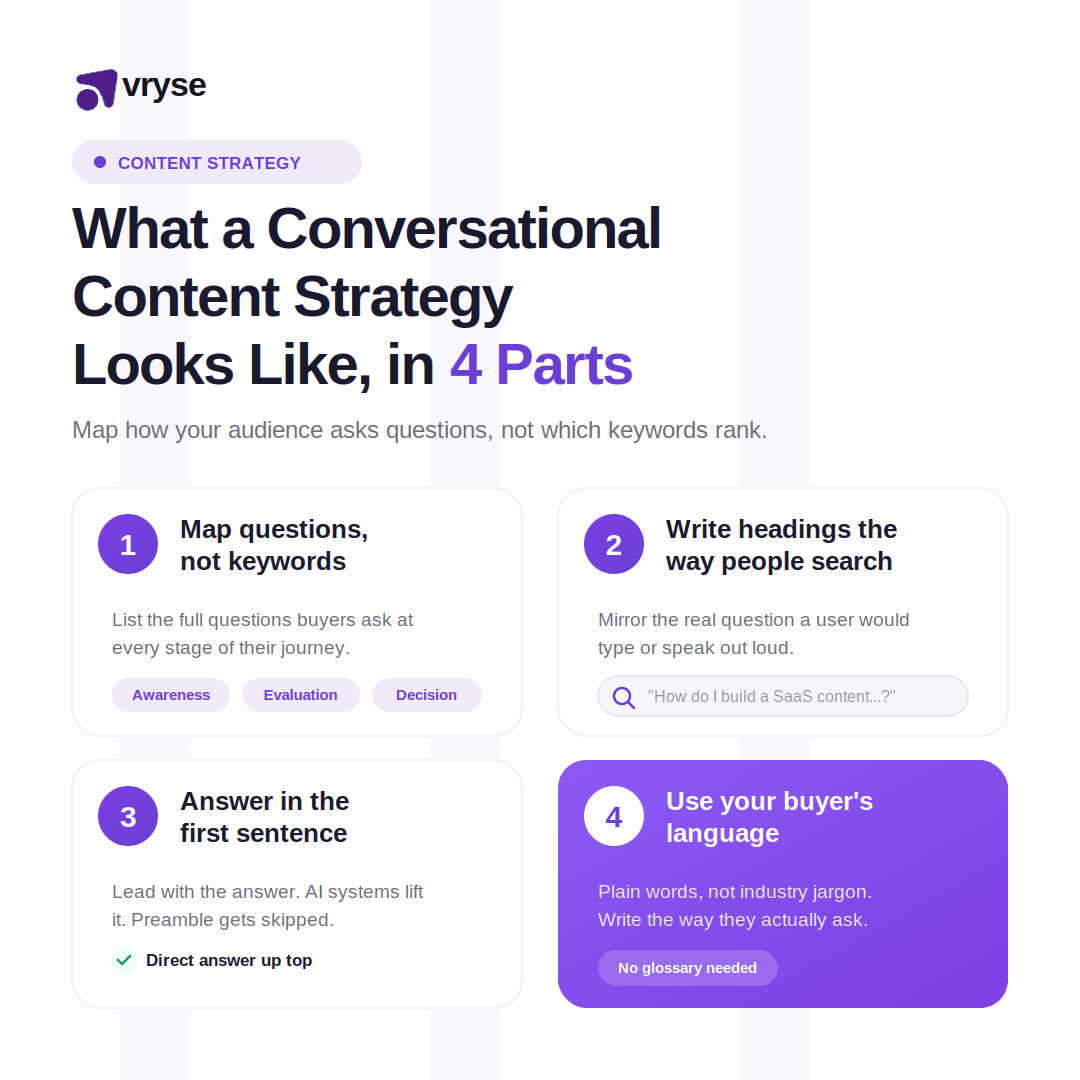
A conversational content strategy starts by mapping how your audience asks questions, not by focusing on which keywords have the highest volume. The process has four distinct parts.
Map questions, not keywords
For every topic you want to cover, list the full questions your audience asks at each stage of their journey:
Awareness questions: "What is [problem]?" / "Why is [issue] happening?"
Evaluation questions: "What is the best [solution] for [specific situation]?"
Decision questions: "How does [your brand] compare to [alternative]?"
Post-purchase questions: "How do I get [specific outcome] with [your product]?"
Each group of questions becomes a content cluster. Each specific question becomes a heading or, where the answer is long enough, a dedicated page. This is the foundation of both topical authority SEO and conversational search optimization: covering every relevant question in depth before a competitor does.
Write headings the way people search
In traditional SEO, headings are often optimized for keywords such as "Content Marketing Strategy" and "SEO Best Practices." In conversational search, headings mirror the question a user would actually type or say:
"How do I build a content marketing strategy for a SaaS brand?"
"What are the most important SEO factors for AI search in 2026?"
This matters because AI platforms retrieve content by matching a user's query to the heading and opening sentence of a page section. If your heading is a keyword phrase, the match is weaker than if it is the question itself.
Answer the heading question in the first sentence
This is the single most important structural change you can make to optimize for conversational search. Every section of your blog should open with a direct answer to the question posed in its heading.
Not: "There are many factors to consider when thinking about content marketing strategy for SaaS brands, and understanding them requires..."
Instead: "A SaaS content marketing strategy works best when it maps content to each stage of the product adoption journey: awareness, activation, retention, and expansion."
The first version delays the answer. The second version is the answer. AI systems retrieve the second version. They skip the first.
Google's content guidance frames this as writing that is genuinely helpful to the reader, not content that appears helpful while burying the actual information.
Write in the language your audience uses, not your industry uses
Conversational search queries use the words a buyer uses, not the words an industry insider uses. A procurement manager searching for supply chain software does not type "procurement orchestration platform." They type "software to manage supplier relationships and purchase orders."
Run your draft through this test: would a knowledgeable person outside your industry understand every sentence without a glossary? If not, rewrite it. Jargon reduces the chance of a conversational match and of an AI citation.
How to Structure a Blog Post for Conversational Search: A Checklist
Use this before publishing any blog post.
Before writing
Is the topic framed as a question your audience would actually ask?
Have you mapped the full set of related questions this post should answer?
Is there a clear primary question the post answers in full?
Structure and format
Does the post open with a direct answer to the primary question in 40 to 80 words?
Are all H2 and H3 headings written as questions or direct answers to questions?
Does the first sentence under each heading directly answer that heading's question?
Are paragraphs short enough that each one contains one idea?
Are lists used where comparisons or steps are involved?
Language and tone
Is the language natural and plain, matching how your audience actually speaks?
Are there any jargon terms that a non-specialist would not immediately understand?
Would any sentence require context from surrounding text to be understood if extracted by an AI?
Technical signals
Does the post include FAQPage or Article schema markup?
Is the post linked to and from related content in the same topical cluster?
Has the post been updated within the last 6 months, or is it scheduled for review?
What Content Formats Work Best for Conversational Search Optimization?
Not all content formats perform equally in LLM conversational search. Here is how common formats rank against conversational retrieval criteria.
Format | Conversational match strength | Why |
FAQ sections | Very high | Mirrors the question-answer pattern of AI queries exactly |
How-to guides with numbered steps | High | Structured, extractable, and directly actionable |
Comparison posts ("X vs Y") | High | Matches evaluation-stage conversational queries precisely |
Definition posts ("What is X") | High | Matches awareness-stage conversational queries precisely |
Listicles without explanation | Medium | Extractable but lacks the depth LLMs look for to verify claims |
Long-form opinion essays | Low | Hard to extract specific answers; low conversational match rate |
Press releases | Very low | Not written for questions; rarely cited in conversational AI |
Semrush's guide to optimizing for AI search engines confirms that AI systems favor content that is clear, structured, and trustworthy, all three of which map directly to FAQ, how-to, and comparison formats over long-form opinion content.
How to Update Existing Blog Posts for Conversational Search
Most brands have existing content that ranks on Google but gets zero citations in AI search. The problem is almost always structural. Here is how to diagnose and fix it.
Step 1: Check whether the post answers a conversational question at all. If the post targets a keyword phrase rather than a question, reframe the title and H1 as the question your audience would actually ask. This is the first signal an AI system reads.
Step 2: Add a Quick Answer block at the top. In 40 to 80 words, directly answer the primary question the post is meant to address. Place it before any other content. This is the format AI systems most reliably lift as a citation.
Step 3: Rewrite the opening sentence of each section. Each H2 or H3 section should open with a direct answer to its heading question. If it opens with context or preamble instead, rewrite the first sentence before touching anything else.
Step 4: Add or expand the FAQ section. A well-structured FAQ at the end of a post provides AI systems with additional, extractable answers. Each question should cover an angle not already addressed in the body, and each answer should begin with a direct response. For a deeper look at how semantic SEO and conversational search overlap, the principles apply to both.
Step 5: Update the publish date and refresh any stale data. LLM conversational search strongly favors recently updated content. Ahrefs' blog optimization guide confirms that freshness signals affect how Google surfaces content. The same logic applies to AI retrieval: a post last updated in 2022 competes poorly against one updated in 2026 for the same question.
Conversational search optimization is the practice of structuring blog content to match the way people ask questions in natural language, whether to Google, ChatGPT, Perplexity, or any AI platform. Instead of targeting short keyword phrases, you write content that directly and completely answers the full question a reader would ask out loud.
Key Takeaways
ChatGPT crossed 1 billion weekly searches in 2025. Perplexity processed 780 million queries in May 2025 alone, up from 230 million in mid-2024, according to TTMS Research.
Google's official AI optimization guide states that content should be written to genuinely help people, with clear structure and direct answers as the primary signals for AI retrieval.
Semrush's 2025 AI Overviews study found that Google AI Overviews appear in 88% of informational search queries, the exact query type where conversational content wins.
A conversational content strategy requires writing for intent, not just keywords: who is asking, what do they actually need to know, and what do they do next.
LLM conversational search favors content that answers the full question in the first paragraph, uses natural language headings, and structures responses so they can be lifted and cited without losing meaning.
What is Conversational Search and why has it Changed Content Strategy?
Conversational search occurs when a user types or speaks a full question rather than a keyword fragment. "Best CRM for small B2B teams under 20 people" instead of "CRM software." "How do I reduce SaaS churn in the first 90 days," instead of "reduce churn."
This shift matters because AI platforms are built to handle natural language queries, not keyword strings. When someone asks ChatGPT or Perplexity a question, the platform retrieves content that most directly and completely answers that full question. Short, keyword-dense content that used to rank on Google does not get cited in conversational AI responses.
Google's AI optimization guide is explicit about this: content should be structured to help people first, with clear, direct answers as the primary signal. The underlying principle is the same whether the retrieval system is a traditional search algorithm or an LLM.
Understanding what GEO means for content strategy clarifies why conversational search optimization is now the connecting layer between traditional SEO and AI visibility. They are not separate strategies. They are the same one, applied correctly.
How is LLM Conversational Search Different From Traditional SEO?
The table below captures the core strategic differences. Both matter in 2026. Neither replaces the other.
Signal | Traditional SEO | LLM conversational search |
Query type targeted | Short keyword phrases | Full natural language questions |
Content format rewarded | Keyword-optimized paragraphs | Direct answers, structured clearly |
Primary ranking signal | Backlinks and keyword relevance | Topic authority and answer completeness |
Winning content format | Long-form with keyword density | Concise, structured, quotable |
What gets measured | Rankings and clicks | Citations and AI-sourced traffic |
Content freshness | Important for competitive terms | Critical: LLMs favor recently updated content |
The most important shift: LLM conversational search does not reward content that builds to an answer. It rewards content that opens with one.
What Does a Conversational Content Strategy Actually Look Like?
A conversational content strategy starts by mapping how your audience asks questions, not by focusing on which keywords have the highest volume. The process has four distinct parts.
Map questions, not keywords
For every topic you want to cover, list the full questions your audience asks at each stage of their journey:
Awareness questions: "What is [problem]?" / "Why is [issue] happening?"
Evaluation questions: "What is the best [solution] for [specific situation]?"
Decision questions: "How does [your brand] compare to [alternative]?"
Post-purchase questions: "How do I get [specific outcome] with [your product]?"
Each group of questions becomes a content cluster. Each specific question becomes a heading or, where the answer is long enough, a dedicated page. This is the foundation of both topical authority SEO and conversational search optimization: covering every relevant question in depth before a competitor does.
Write headings the way people search
In traditional SEO, headings are often optimized for keywords such as "Content Marketing Strategy" and "SEO Best Practices." In conversational search, headings mirror the question a user would actually type or say:
"How do I build a content marketing strategy for a SaaS brand?"
"What are the most important SEO factors for AI search in 2026?"
This matters because AI platforms retrieve content by matching a user's query to the heading and opening sentence of a page section. If your heading is a keyword phrase, the match is weaker than if it is the question itself.
Answer the heading question in the first sentence
This is the single most important structural change you can make to optimize for conversational search. Every section of your blog should open with a direct answer to the question posed in its heading.
Not: "There are many factors to consider when thinking about content marketing strategy for SaaS brands, and understanding them requires..."
Instead: "A SaaS content marketing strategy works best when it maps content to each stage of the product adoption journey: awareness, activation, retention, and expansion."
The first version delays the answer. The second version is the answer. AI systems retrieve the second version. They skip the first.
Google's content guidance frames this as writing that is genuinely helpful to the reader, not content that appears helpful while burying the actual information.
Write in the language your audience uses, not your industry uses
Conversational search queries use the words a buyer uses, not the words an industry insider uses. A procurement manager searching for supply chain software does not type "procurement orchestration platform." They type "software to manage supplier relationships and purchase orders."
Run your draft through this test: would a knowledgeable person outside your industry understand every sentence without a glossary? If not, rewrite it. Jargon reduces the chance of a conversational match and of an AI citation.
How to Structure a Blog Post for Conversational Search: A Checklist
Use this before publishing any blog post.
Before writing
Is the topic framed as a question your audience would actually ask?
Have you mapped the full set of related questions this post should answer?
Is there a clear primary question the post answers in full?
Structure and format
Does the post open with a direct answer to the primary question in 40 to 80 words?
Are all H2 and H3 headings written as questions or direct answers to questions?
Does the first sentence under each heading directly answer that heading's question?
Are paragraphs short enough that each one contains one idea?
Are lists used where comparisons or steps are involved?
Language and tone
Is the language natural and plain, matching how your audience actually speaks?
Are there any jargon terms that a non-specialist would not immediately understand?
Would any sentence require context from surrounding text to be understood if extracted by an AI?
Technical signals
Does the post include FAQPage or Article schema markup?
Is the post linked to and from related content in the same topical cluster?
Has the post been updated within the last 6 months, or is it scheduled for review?
What Content Formats Work Best for Conversational Search Optimization?
Not all content formats perform equally in LLM conversational search. Here is how common formats rank against conversational retrieval criteria.
Format | Conversational match strength | Why |
FAQ sections | Very high | Mirrors the question-answer pattern of AI queries exactly |
How-to guides with numbered steps | High | Structured, extractable, and directly actionable |
Comparison posts ("X vs Y") | High | Matches evaluation-stage conversational queries precisely |
Definition posts ("What is X") | High | Matches awareness-stage conversational queries precisely |
Listicles without explanation | Medium | Extractable but lacks the depth LLMs look for to verify claims |
Long-form opinion essays | Low | Hard to extract specific answers; low conversational match rate |
Press releases | Very low | Not written for questions; rarely cited in conversational AI |
Semrush's guide to optimizing for AI search engines confirms that AI systems favor content that is clear, structured, and trustworthy, all three of which map directly to FAQ, how-to, and comparison formats over long-form opinion content.
How to Update Existing Blog Posts for Conversational Search
Most brands have existing content that ranks on Google but gets zero citations in AI search. The problem is almost always structural. Here is how to diagnose and fix it.
Step 1: Check whether the post answers a conversational question at all. If the post targets a keyword phrase rather than a question, reframe the title and H1 as the question your audience would actually ask. This is the first signal an AI system reads.
Step 2: Add a Quick Answer block at the top. In 40 to 80 words, directly answer the primary question the post is meant to address. Place it before any other content. This is the format AI systems most reliably lift as a citation.
Step 3: Rewrite the opening sentence of each section. Each H2 or H3 section should open with a direct answer to its heading question. If it opens with context or preamble instead, rewrite the first sentence before touching anything else.
Step 4: Add or expand the FAQ section. A well-structured FAQ at the end of a post provides AI systems with additional, extractable answers. Each question should cover an angle not already addressed in the body, and each answer should begin with a direct response. For a deeper look at how semantic SEO and conversational search overlap, the principles apply to both.
Step 5: Update the publish date and refresh any stale data. LLM conversational search strongly favors recently updated content. Ahrefs' blog optimization guide confirms that freshness signals affect how Google surfaces content. The same logic applies to AI retrieval: a post last updated in 2022 competes poorly against one updated in 2026 for the same question.
Frequently Asked Questions
Frequently Asked Questions
What is conversational search optimization?
Conversational search optimization is the process of structuring content to match natural language questions rather than keyword phrases. It involves writing direct answers under question-based headings, using plain language your audience would naturally use, and formatting content so AI systems can extract and cite it without additional context.
How does LLM conversational search affect existing content strategy?
It shifts the priority from keyword density to answer completeness. Content that was built to answer over several paragraphs worked in traditional SEO. LLM conversational search rewards content that delivers the answer in the first sentence, then expands. Most existing blog posts need structural editing, not complete rewrites, to meet this standard.
Does conversational content strategy hurt traditional SEO rankings?
No. The structural changes that improve conversational search performance, direct answers, question-based headings, and clear paragraphs also improve traditional SEO performance by better matching search intent. Ahrefs confirms that aligning content to search intent is one of the most consistent ranking factors in traditional search.
Which AI platforms does conversational search optimization apply to?
All of them: Google AI Overviews, AI Mode, ChatGPT, Perplexity, Gemini, and Claude. The structural principles are the same across every platform because they all use LLMs to retrieve and synthesize answers. The brand that shows up consistently across all of them is the one that has built the most comprehensive, well-structured conversational content strategy. Vryse's AI visibility dashboard tracks citation rates across all major platforms, so you can measure exactly where you appear and where gaps remain.
Related Articles
Related Articles
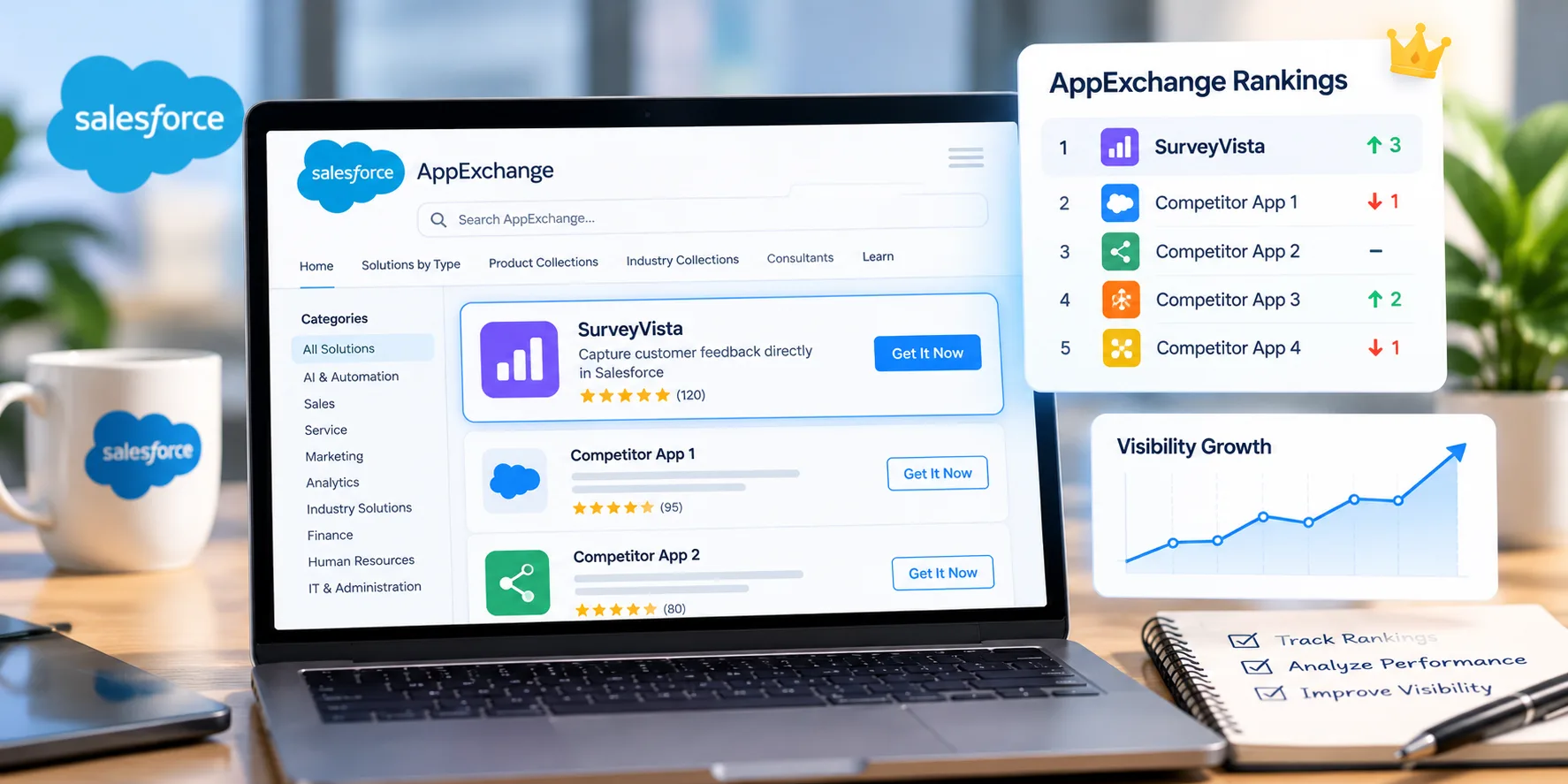
How to Track Salesforce AppExchange Rankings and Improve Your App’s Visibility
Track your AppExchange rankings, identify keyword opportunities, and optimize your Salesforce listing to improve marketplace visibility, attract qualified buyers, and drive more installs.

Ashish Kamathi, SEO Expert
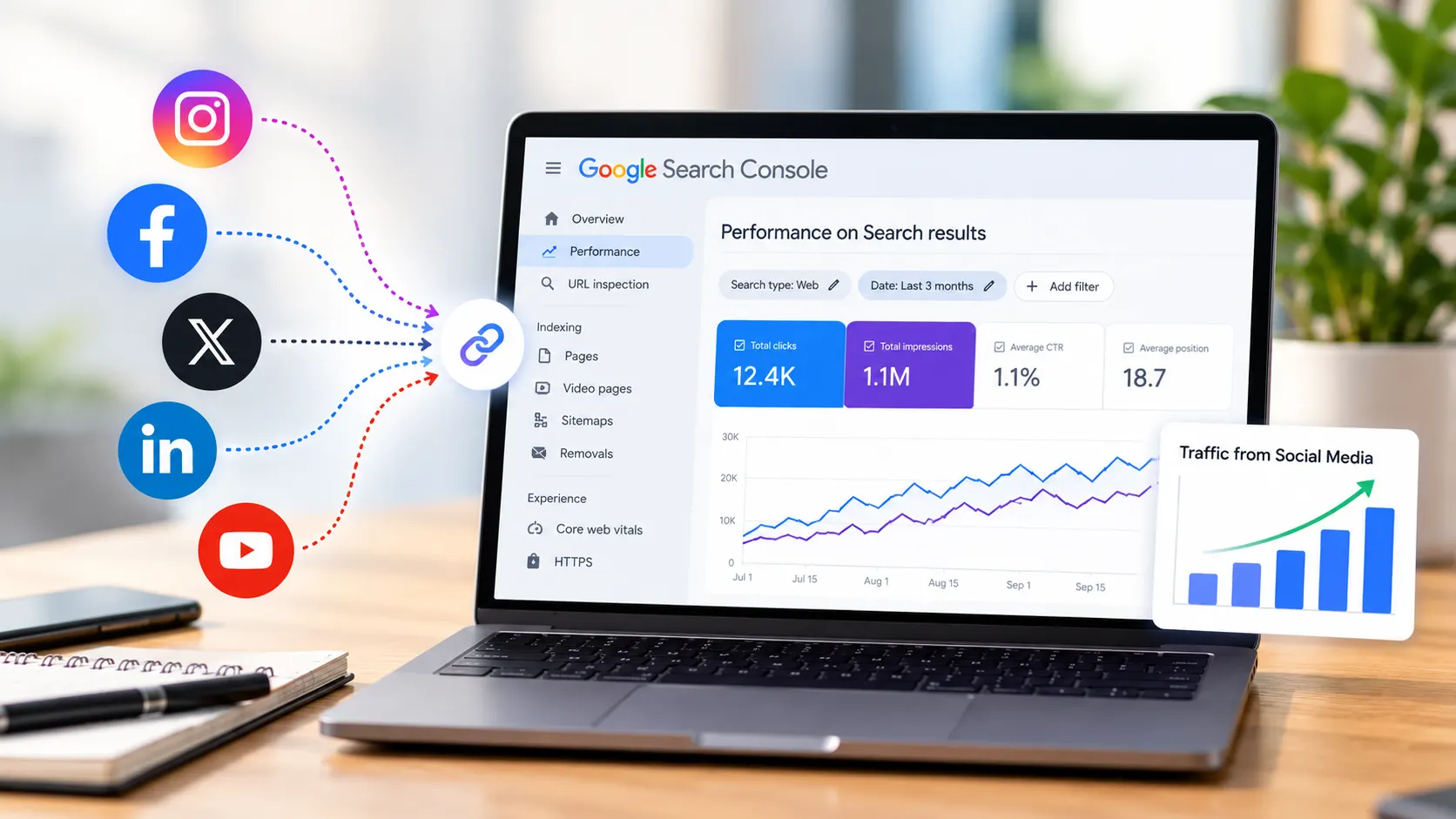
How to Add Social Media to Google Search Console and Track Their Performance
Learn how Google Search Console handles social media, what platform properties can track, and how to measure social performance alongside your website's organic search data.

Shraddha Thuwal

Domain Migration Checklist: A Step-by-Step Guide to Protect Rankings and Traffic
A successful domain migration requires careful SEO planning. Follow this checklist to manage redirects, preserve rankings, protect traffic, and avoid common migration issues.
Shraddha Thuwal
How to Track Salesforce AppExchange Rankings and Improve Your App’s Visibility
Track your AppExchange rankings, identify keyword opportunities, and optimize your Salesforce listing to improve marketplace visibility, attract qualified buyers, and drive more installs.
Ashish Kamathi, SEO Expert
How to Add Social Media to Google Search Console and Track Their Performance
Learn how Google Search Console handles social media, what platform properties can track, and how to measure social performance alongside your website's organic search data.
Shraddha Thuwal
Get Visibility, Everywhere



























Just drop us your email and we’ll reach out
Get Visibility, Everywhere
Just drop us your email and we’ll reach out
Get Visibility, Everywhere
Just drop us your email and we’ll reach out
Our weekly newsletter contains insights from strategies we use for our clients. We don’t spam.
Copyright © 2026 Vryse
Our weekly newsletter contains insights from strategies we use for our clients. We don’t spam.
Copyright © 2026 Vryse