AI & LLM SEO
AI & LLM SEO
How ChatGPT Chooses Its Sources: A Complete Guide
How ChatGPT Chooses Its Sources: A Complete Guide
Learn how ChatGPT chooses sources, evaluates website credibility, and selects trusted content for AI search, plus practical ways to improve your chances of being cited.

Ashish Kamathi, SEO Expert
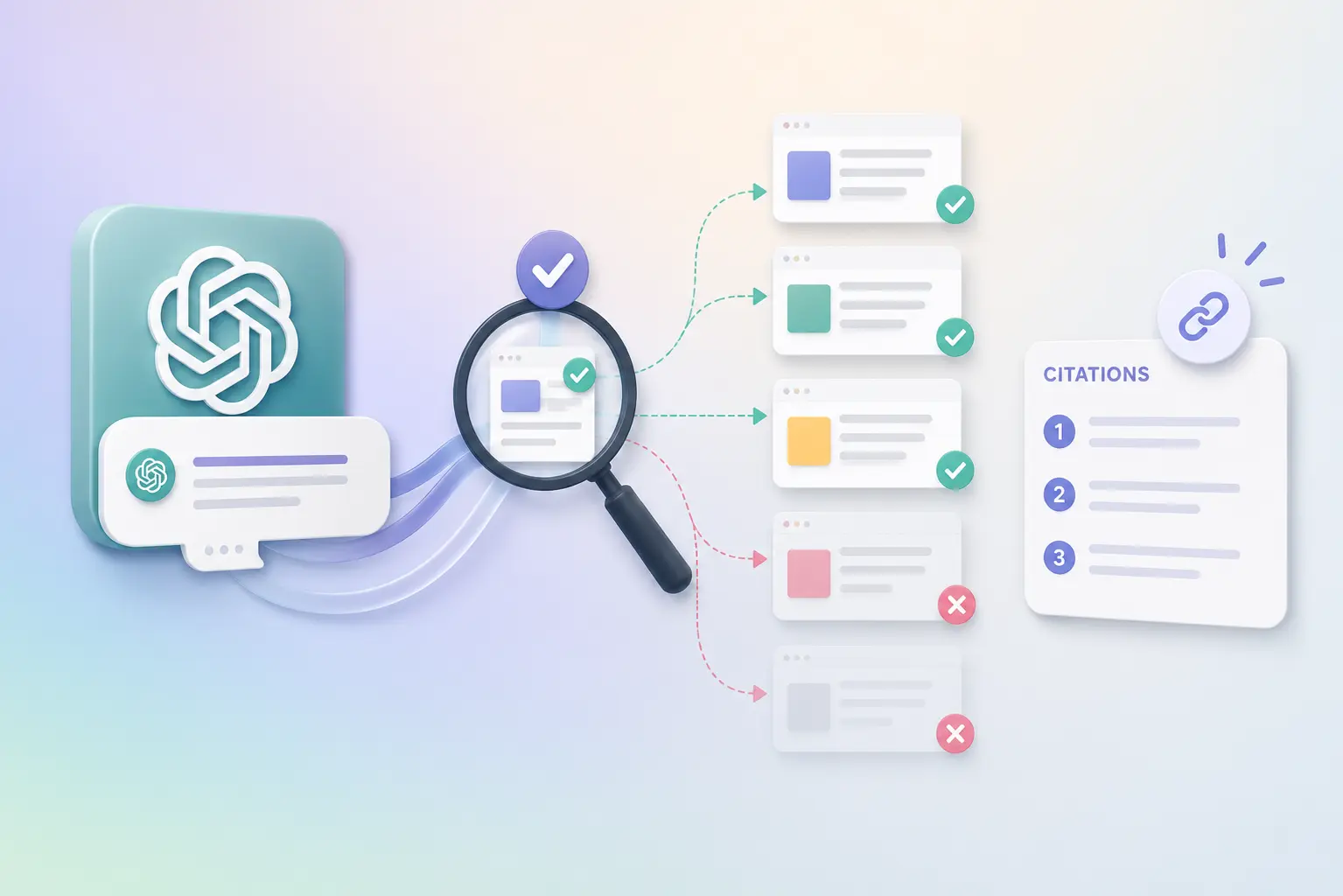
ChatGPT selects sources through a multi-layered process that evaluates content structure, domain authority, freshness, topical relevance, and factual credibility. It does not rank a list of ten links. It retrieves, compares, and synthesizes content from multiple sources into a single answer, citing only the pages it judges most trustworthy for that specific query. Understanding how ChatGPT chooses sources is the starting point for making your content citable.
Key Takeaways
ChatGPT Search is a fine-tuned version of GPT-4o that leverages third-party search providers and partner content to generate real-time answers with inline citations, according to OpenAI's official announcement.
Sites with over 32,000 referring domains are 3.5x more likely to be cited by ChatGPT than sites with fewer than 200, according to SE Ranking's November 2025 research.
Pages with FAQ schema and structured answer blocks receive approximately 40% higher weighting in ChatGPT's source selection than pages without them (Authoritas, 2025).
A Magna study of 10,247 prompts across 47 industries found that sites with deep niche expertise performed 3.6x better than sites with broad general coverage.
44% of SaaS brands with strong Google rankings have no ChatGPT visibility at all (EMGI Group, April 2026). Google rankings do not automatically transfer to AI citation.
How Does the ChatGPT Source Selection Process Actually Work?
ChatGPT does not work like a search engine. When you ask Google a question, it returns a ranked list of pages. When you ask ChatGPT, it searches the web, reads multiple pages, compares them, and synthesizes a single answer decorated with inline citations.
OpenAI describes ChatGPT Search as a fine-tuned GPT-4o model that leverages third-party search providers and content from publishing partners. It was trained using synthetic data generation and distilled outputs from OpenAI's o1-preview model. The system searches, retrieves, evaluates, and then composes, deciding in real time which sources to cite and which to discard.
According to Zapier's testing of ChatGPT's browsing behaviour, the model typically runs multiple sequential searches per query, translates user questions into statement-based search terms, and aggregates results across several pages before composing a response. It does not simply pull from the first result. It evaluates each retrieved page against a set of credibility and relevance criteria before deciding whether to cite it.
What Are the Core AI Source Credibility Factors?
Content Structure and Extractability
ChatGPT favours content it can parse quickly. Pages using semantic HTML (proper H1, H2, H3 hierarchy), FAQ sections, comparison tables, and direct answer blocks at the top of each section receive significantly more citations.
According to Authoritas (2025), pages with FAQ schema and inline citations are weighted approximately 40% higher in ChatGPT's source selection. The Magna study across 47 industries found that structured content formats (clear headers, definition lists, comparison tables) received 2.3x more citations than unstructured prose.
The practical application: answer the query in the first 40 to 60 words of each section. Use tables for comparisons. Use lists for steps. Front-load the answer, then expand. This is the same principle behind conversational search optimization and it applies directly to ChatGPT source selection.
Domain Authority and Trust Signals
ChatGPT is risk-averse. It prefers sources it can confidently attribute, which means backlink profiles function as credibility signals rather than just ranking factors.
SE Ranking's November 2025 data found that sites with over 32,000 referring domains are 3.5x more likely to be cited than sites with fewer than 200. Zapier's testing confirmed that ChatGPT prioritises information from well-known outlets, gives high marks to blogs of reputable brands, and uses official government or institutional sources for regulatory, public health, and statistical queries.
Author bios and credentials also influence selection. ChatGPT prioritises content from recognised experts and experienced journalists, with affiliations to well-known institutions carrying additional weight. This aligns with Google's E-E-A-T framework, but in ChatGPT's case, the signal determines citation, not ranking position.
Content Freshness
ChatGPT has a strong recency bias. Content updated within 30 days receives 3.2x more citations than older material. Pages updated within three months averaged 6 citations in a Search Engine Journal study, compared to 3.6 for outdated content.
Zapier found that ChatGPT often applies aggressive recency filters, sometimes limiting results to the last week or month for trend-related queries. It also appends terms like "current," "latest," or a specific year to its internal search queries.
The freshness signal is not about publication date alone. It is about whether the content reflects current conditions: updated statistics, recent examples, and a visible "Last updated" timestamp on priority pages.
Topical Depth and Niche Authority
Broad coverage loses to deep expertise. The Magna study found that sites demonstrating deep expertise in a narrow topic performed 3.6x better than sites with broad general content. ChatGPT consistently cites the most topically authoritative source on a subject, not the most generally popular one.
Objectivity and Transparency
ChatGPT deprioritises content with visible commercial bias. Zapier's testing found that the model attempts to downgrade sources where affiliate marketing might influence results, and it notes inherent biases of company blogs toward their own products. It also prioritises content that cites its own sources, methodology details, and transparent authorship.
Product review sites specific to a certain category (like dedicated software review platforms) tend to be selected over general sites. Transparency in how products were tested or ranked is a positive signal.
Factor | What ChatGPT Evaluates | Signal Strength |
Content structure | Semantic HTML, FAQ sections, tables, direct answers | Very strong: 40% higher citation weight with schema |
Domain authority | Referring domains, institutional affiliations | Very strong: 3.5x more citations above 32K referring domains |
Freshness | Last updated date, current statistics and examples | Strong: 3.2x more citations for content updated within 30 days |
Topical depth | Niche expertise, comprehensive coverage of a subject | Strong: 3.6x better performance for deep niche content |
Objectivity | Source citations, methodology, transparent authorship | Moderate: deprioritises obvious commercial bias |
What Sources Does ChatGPT Actually Cite Most?
ChatGPT draws from two distinct knowledge layers: its training data (a static corpus it learned from) and real-time web browsing (live retrieval when search is triggered).
For training data, Wikipedia accounts for approximately 27% of ChatGPT's training citations, making it the single largest source in the model's knowledge base.
For real-time browsing, ChatGPT pulls from a wider set including news outlets, brand websites, directories, review platforms, and community forums.
A critical finding from EMGI Group data (April 2026): 44% of SaaS brands with strong Google rankings have no ChatGPT visibility at all. The overlap between Google's top 10 and ChatGPT's cited sources is significantly lower than most brands assume.
Understanding why each AI platform shows different answers explains why a source trusted by ChatGPT may not be cited by Perplexity or Gemini, and vice versa.
How To Make Your Content a Trusted Source in AI Search
Based on the data above, here is the priority order for becoming a source ChatGPT cites.
Immediate fixes (week 1 to 2):
Add a direct answer in the first 40 to 60 words of every key page section
Implement FAQ schema on pages targeting informational and comparison queries
Add a visible "Last updated" timestamp and refresh any statistics older than 6 months
Ensure semantic HTML: proper heading hierarchy, clean table markup, no walls of text
Short-term improvements (month 1 to 3):
Build dedicated pages for each core topic rather than covering everything on one page
Add author bios with verifiable credentials and institutional affiliations
Cite primary sources within your content (studies, datasets, official publications)
Update your top 10 pages monthly to maintain the 30-day freshness advantage
Ongoing authority building (month 3+):
Earn backlinks and mentions from authoritative third-party sources in your niche
Get listed on category-specific directories and review platforms
Publish original research or data that other sources will cite
Build topical clusters that demonstrate comprehensive expertise on your core subjects
Vryse applied this approach for a co-living hospitality brand in Bangalore that had minimal organic visibility and no AI search presence. By fixing technical SEO issues, restructuring content around the specific queries prospective tenants ask, and building local authority signals, the brand achieved a 200% increase in organic traffic and over 550 daily clicks within 6 months. The full case study is on Vryse's site.
How Can I Track Whether ChatGPT Is Citing My Content?
Run your core buyer queries in ChatGPT with browsing enabled, in incognito sessions, and record which sources appear. For systematic tracking, Vryse's AI visibility dashboard monitors citation rates across ChatGPT, Perplexity, Gemini, and Google AI Overviews. Vryse's free ChatGPT Search Insights Chrome extension also reveals the hidden search queries ChatGPT runs behind the scenes when generating answers.
ChatGPT selects sources through a multi-layered process that evaluates content structure, domain authority, freshness, topical relevance, and factual credibility. It does not rank a list of ten links. It retrieves, compares, and synthesizes content from multiple sources into a single answer, citing only the pages it judges most trustworthy for that specific query. Understanding how ChatGPT chooses sources is the starting point for making your content citable.
Key Takeaways
ChatGPT Search is a fine-tuned version of GPT-4o that leverages third-party search providers and partner content to generate real-time answers with inline citations, according to OpenAI's official announcement.
Sites with over 32,000 referring domains are 3.5x more likely to be cited by ChatGPT than sites with fewer than 200, according to SE Ranking's November 2025 research.
Pages with FAQ schema and structured answer blocks receive approximately 40% higher weighting in ChatGPT's source selection than pages without them (Authoritas, 2025).
A Magna study of 10,247 prompts across 47 industries found that sites with deep niche expertise performed 3.6x better than sites with broad general coverage.
44% of SaaS brands with strong Google rankings have no ChatGPT visibility at all (EMGI Group, April 2026). Google rankings do not automatically transfer to AI citation.
How Does the ChatGPT Source Selection Process Actually Work?
ChatGPT does not work like a search engine. When you ask Google a question, it returns a ranked list of pages. When you ask ChatGPT, it searches the web, reads multiple pages, compares them, and synthesizes a single answer decorated with inline citations.
OpenAI describes ChatGPT Search as a fine-tuned GPT-4o model that leverages third-party search providers and content from publishing partners. It was trained using synthetic data generation and distilled outputs from OpenAI's o1-preview model. The system searches, retrieves, evaluates, and then composes, deciding in real time which sources to cite and which to discard.
According to Zapier's testing of ChatGPT's browsing behaviour, the model typically runs multiple sequential searches per query, translates user questions into statement-based search terms, and aggregates results across several pages before composing a response. It does not simply pull from the first result. It evaluates each retrieved page against a set of credibility and relevance criteria before deciding whether to cite it.
What Are the Core AI Source Credibility Factors?
Content Structure and Extractability
ChatGPT favours content it can parse quickly. Pages using semantic HTML (proper H1, H2, H3 hierarchy), FAQ sections, comparison tables, and direct answer blocks at the top of each section receive significantly more citations.
According to Authoritas (2025), pages with FAQ schema and inline citations are weighted approximately 40% higher in ChatGPT's source selection. The Magna study across 47 industries found that structured content formats (clear headers, definition lists, comparison tables) received 2.3x more citations than unstructured prose.
The practical application: answer the query in the first 40 to 60 words of each section. Use tables for comparisons. Use lists for steps. Front-load the answer, then expand. This is the same principle behind conversational search optimization and it applies directly to ChatGPT source selection.
Domain Authority and Trust Signals
ChatGPT is risk-averse. It prefers sources it can confidently attribute, which means backlink profiles function as credibility signals rather than just ranking factors.
SE Ranking's November 2025 data found that sites with over 32,000 referring domains are 3.5x more likely to be cited than sites with fewer than 200. Zapier's testing confirmed that ChatGPT prioritises information from well-known outlets, gives high marks to blogs of reputable brands, and uses official government or institutional sources for regulatory, public health, and statistical queries.
Author bios and credentials also influence selection. ChatGPT prioritises content from recognised experts and experienced journalists, with affiliations to well-known institutions carrying additional weight. This aligns with Google's E-E-A-T framework, but in ChatGPT's case, the signal determines citation, not ranking position.
Content Freshness
ChatGPT has a strong recency bias. Content updated within 30 days receives 3.2x more citations than older material. Pages updated within three months averaged 6 citations in a Search Engine Journal study, compared to 3.6 for outdated content.
Zapier found that ChatGPT often applies aggressive recency filters, sometimes limiting results to the last week or month for trend-related queries. It also appends terms like "current," "latest," or a specific year to its internal search queries.
The freshness signal is not about publication date alone. It is about whether the content reflects current conditions: updated statistics, recent examples, and a visible "Last updated" timestamp on priority pages.
Topical Depth and Niche Authority
Broad coverage loses to deep expertise. The Magna study found that sites demonstrating deep expertise in a narrow topic performed 3.6x better than sites with broad general content. ChatGPT consistently cites the most topically authoritative source on a subject, not the most generally popular one.
Objectivity and Transparency
ChatGPT deprioritises content with visible commercial bias. Zapier's testing found that the model attempts to downgrade sources where affiliate marketing might influence results, and it notes inherent biases of company blogs toward their own products. It also prioritises content that cites its own sources, methodology details, and transparent authorship.
Product review sites specific to a certain category (like dedicated software review platforms) tend to be selected over general sites. Transparency in how products were tested or ranked is a positive signal.
Factor | What ChatGPT Evaluates | Signal Strength |
Content structure | Semantic HTML, FAQ sections, tables, direct answers | Very strong: 40% higher citation weight with schema |
Domain authority | Referring domains, institutional affiliations | Very strong: 3.5x more citations above 32K referring domains |
Freshness | Last updated date, current statistics and examples | Strong: 3.2x more citations for content updated within 30 days |
Topical depth | Niche expertise, comprehensive coverage of a subject | Strong: 3.6x better performance for deep niche content |
Objectivity | Source citations, methodology, transparent authorship | Moderate: deprioritises obvious commercial bias |
What Sources Does ChatGPT Actually Cite Most?
ChatGPT draws from two distinct knowledge layers: its training data (a static corpus it learned from) and real-time web browsing (live retrieval when search is triggered).
For training data, Wikipedia accounts for approximately 27% of ChatGPT's training citations, making it the single largest source in the model's knowledge base.
For real-time browsing, ChatGPT pulls from a wider set including news outlets, brand websites, directories, review platforms, and community forums.
A critical finding from EMGI Group data (April 2026): 44% of SaaS brands with strong Google rankings have no ChatGPT visibility at all. The overlap between Google's top 10 and ChatGPT's cited sources is significantly lower than most brands assume.
Understanding why each AI platform shows different answers explains why a source trusted by ChatGPT may not be cited by Perplexity or Gemini, and vice versa.
How To Make Your Content a Trusted Source in AI Search
Based on the data above, here is the priority order for becoming a source ChatGPT cites.
Immediate fixes (week 1 to 2):
Add a direct answer in the first 40 to 60 words of every key page section
Implement FAQ schema on pages targeting informational and comparison queries
Add a visible "Last updated" timestamp and refresh any statistics older than 6 months
Ensure semantic HTML: proper heading hierarchy, clean table markup, no walls of text
Short-term improvements (month 1 to 3):
Build dedicated pages for each core topic rather than covering everything on one page
Add author bios with verifiable credentials and institutional affiliations
Cite primary sources within your content (studies, datasets, official publications)
Update your top 10 pages monthly to maintain the 30-day freshness advantage
Ongoing authority building (month 3+):
Earn backlinks and mentions from authoritative third-party sources in your niche
Get listed on category-specific directories and review platforms
Publish original research or data that other sources will cite
Build topical clusters that demonstrate comprehensive expertise on your core subjects
Vryse applied this approach for a co-living hospitality brand in Bangalore that had minimal organic visibility and no AI search presence. By fixing technical SEO issues, restructuring content around the specific queries prospective tenants ask, and building local authority signals, the brand achieved a 200% increase in organic traffic and over 550 daily clicks within 6 months. The full case study is on Vryse's site.
How Can I Track Whether ChatGPT Is Citing My Content?
Run your core buyer queries in ChatGPT with browsing enabled, in incognito sessions, and record which sources appear. For systematic tracking, Vryse's AI visibility dashboard monitors citation rates across ChatGPT, Perplexity, Gemini, and Google AI Overviews. Vryse's free ChatGPT Search Insights Chrome extension also reveals the hidden search queries ChatGPT runs behind the scenes when generating answers.
Frequently Asked Questions
Frequently Asked Questions
Does Ranking on Google Guarantee ChatGPT Will Cite My Page?
No. 44% of SaaS brands with strong Google rankings have zero ChatGPT visibility. ChatGPT applies its own selection criteria: content structure, freshness, topical authority, and source transparency. These overlap with Google's ranking factors but are weighted differently and evaluated independently.
How Important Is Content Freshness for ChatGPT Citations?
Content updated within 30 days receives 3.2x more citations than older material. For time-sensitive queries, ChatGPT often restricts its search to results from the past week or month. Even for evergreen topics, a page with recent data and a visible update date will outperform an identical page that has not been touched in 6 months.
Does ChatGPT Prefer Long-Form or Short-Form Content?
Neither, specifically. ChatGPT prefers content that is structured for extraction: direct answers at the top of each section, clear headings, tables for comparisons, and FAQ blocks. A 1,200-word article with strong structure will be cited over a 5,000-word article written as continuous prose.
Related Articles
Related Articles
How to Track Salesforce AppExchange Rankings and Improve Your App’s Visibility
Track your AppExchange rankings, identify keyword opportunities, and optimize your Salesforce listing to improve marketplace visibility, attract qualified buyers, and drive more installs.
Ashish Kamathi, SEO Expert
How to Add Social Media to Google Search Console and Track Their Performance
Learn how Google Search Console handles social media, what platform properties can track, and how to measure social performance alongside your website's organic search data.

Shraddha Thuwal

Domain Migration Checklist: A Step-by-Step Guide to Protect Rankings and Traffic
A successful domain migration requires careful SEO planning. Follow this checklist to manage redirects, preserve rankings, protect traffic, and avoid common migration issues.
Shraddha Thuwal
How to Track Salesforce AppExchange Rankings and Improve Your App’s Visibility
Track your AppExchange rankings, identify keyword opportunities, and optimize your Salesforce listing to improve marketplace visibility, attract qualified buyers, and drive more installs.
Ashish Kamathi, SEO Expert
How to Add Social Media to Google Search Console and Track Their Performance
Learn how Google Search Console handles social media, what platform properties can track, and how to measure social performance alongside your website's organic search data.
Shraddha Thuwal
Get Visibility, Everywhere



























Just drop us your email and we’ll reach out
Get Visibility, Everywhere
Just drop us your email and we’ll reach out
Get Visibility, Everywhere
Just drop us your email and we’ll reach out
Our weekly newsletter contains insights from strategies we use for our clients. We don’t spam.
Copyright © 2026 Vryse
Our weekly newsletter contains insights from strategies we use for our clients. We don’t spam.
Copyright © 2026 Vryse