Technical SEO
Technical SEO
Schema Markup for AI Search: Complete Guide
Schema Markup for AI Search: Complete Guide
Discover how structured data and JSON-LD schema markup help search engines and AI systems understand your content, strengthen entity recognition, and improve visibility.

Ashish Kamathi, SEO Expert

Schema markup is code added to your website that tells search engines and AI platforms exactly what your content means, not just what it says. For AI search, structured data for AI search helps systems like Google AI Mode, ChatGPT, and Perplexity parse, verify, and cite your content more accurately. It is not a guaranteed citation trigger, but it is one of the clearest signals you can send about what your page is, who you are, and what you know.
Key Takeaways
According to an SEranking dataset, roughly 71% of pages cited by ChatGPT include structured data, and about 65% of pages cited by Google AI Mode include it.
An Ahrefs data study of 1,885 pages published in May 2026 found no statistically significant increase in AI citations after adding schema to pages already receiving 100+ AI Overview citations. Schema is likely more important for pages that are not yet cited at all.
JSON-LD is Google's recommended format for structured data and the format most consistently parsed by AI systems. Use it over Microdata or RDFa.
Google's March 2026 core update reduced the visibility of rich results for misused FAQ, HowTo, and Review schema. Accurate, intent-matched schema retained, improving results.
As of 2025, only about 12.4% of all registered domains have implemented Schema.org structured data, according to available data. That gap is a competitive opportunity.
What is Schema Markup, and Why Does it Matter for AI Search?
Schema markup is code, written in a standardized vocabulary from Schema.org, that you add to your website to explicitly label your content. Instead of leaving a search engine or AI system to infer that a number on your page is a price, schema tells it directly: this is a price, this is the currency, this is the product it belongs to.
As Semrush explains in its schema markup guide, schema markup makes your content eligible for rich results in Google Search, such as star ratings, product availability, and event times. But its role has expanded significantly beyond traditional search.
AI engines like ChatGPT, Gemini, and Perplexity do not read pages the way humans do. They extract meaning from raw text and try to understand relationships between entities. Structured data provides an explicit framework that removes ambiguity: this is an organization, this is a product, this is an FAQ that directly answers a question. That clarity is useful to any system trying to synthesize an accurate answer from multiple sources.
Understanding how schema markup for AI search fits into a broader semantic SEO strategy is the right starting point. Schema is the technical layer. Content depth and topical authority are the strategic layer. Both are needed.
JSON-LD, Microdata, or RDFa: Which Format Should You Use?
There are three ways to add structured data to a page. The choice matters specifically for AI search.
Format | How it works | Recommended for AI search? |
JSON-LD | Separate script block in the page head or body. Does not touch the HTML structure. | Yes. Google's recommended format. Most consistently parsed by AI systems. |
Microdata | Embedded directly into HTML tags. Harder to maintain at scale. | No. More error-prone and harder for AI systems to extract cleanly. |
RDFa | Also embedded in HTML. Flexible but complex. | No. Rarely used in practice, and lower AI system support. |
Google's structured data documentation explicitly recommends JSON-LD as the preferred format. For AI search specifically, JSON-LD's separation from HTML makes it easier for LLMs to parse programmatically without misreading surrounding page content. Use JSON-LD for all new implementations.
Which Schema Types Matter Most for AI Search?
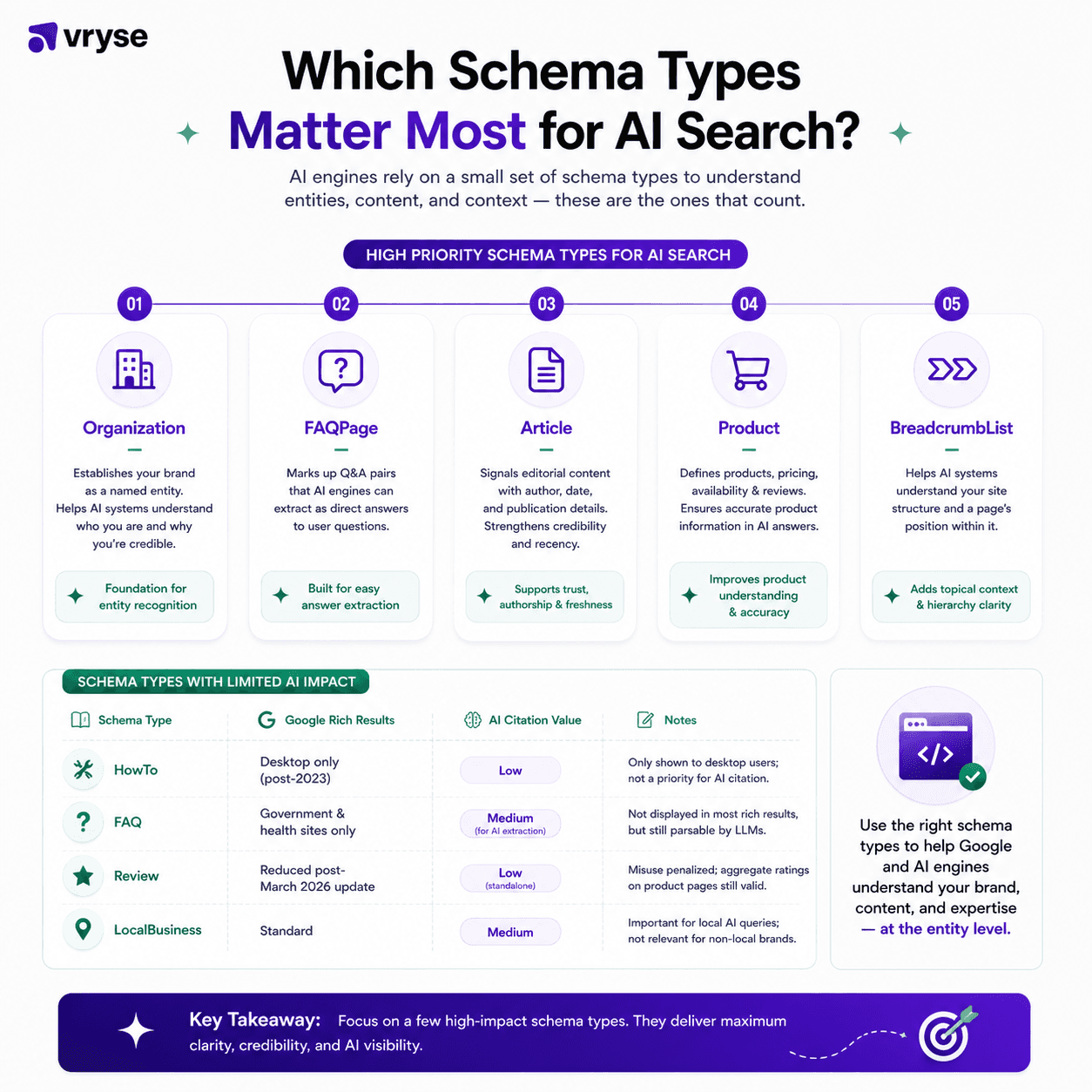
Ahrefs documents over 823 schema types on Schema.org, but Google only supports a specific subset for rich results, and AI systems prioritize an even narrower set for citation and entity understanding. Here are the types that matter most for schema markup, SEO, and AI visibility.
High Priority Schema Types for AI Search
Organization Defines your brand as a named entity: your legal name, logo, website, social profiles, contact information, and founding details. This is the single most important schema type for entity recognition. AI systems use it to understand who you are before deciding whether to cite you.
FAQPage marks up question-and-answer pairs in a format that AI engines can extract directly. The FAQPage schema is one of the clearest signals you can give an LLM that a page contains a direct answer to a specific question. Note: since Google's August 2023 update, FAQ rich results are now only shown for authoritative government and health sites in traditional search. But the schema type remains valuable for AI retrieval regardless of eligibility for rich results.
Article Signals that a page is editorial content, names the author, provides a publish date, and identifies the publication. Authorship and recency are signals AI systems use to assess credibility. Google's article schema documentation notes that it helps Google better understand your page and display enhanced results in Google News.
Product for ecommerce and SaaS pricing pages. Defines the product name, description, price, availability, and reviews. AI systems increasingly surface product information in answer responses, and clean product schema reduces the chance of misattribution.
BreadcrumbList helps AI systems understand your site structure and where a page sits within it. Useful for establishing topical context.
Schema Types With Limited AI Impact
Schema type | Google rich results | AI citation value | Notes |
HowTo | Desktop only (post-2023) | Low | Only shown to desktop users; not a priority for AI citation |
FAQ | Government and health sites only | Medium for AI extraction | Not displayed in most rich results, but still parsable by LLMs |
Review | Reduced post-March 2026 update | Low standalone | Misuse penalized; aggregate ratings on product pages still valid |
LocalBusiness | Standard | Medium | Important for local AI queries; not relevant for non-local brands |
How to Implement JSON-LD Schema Markup: a Step-by-Step Guide
Step 1: Decide Which Schema Type Fits the Page
Match the schema type to the page's primary purpose. A blog post gets an Article schema. A product page gets Product schema. A contact or about page gets the Organization schema. A support page with questions and answers gets the FAQPage schema. Do not add schema types that do not match the page's actual content. Google's March 2026 core update specifically penalized mismatched schema implementations.
Step 2: Write the JSON-LD Block
JSON-LD schema markup goes inside a <script type="application/ld+json"> tag, placed in the <head> or <body> of the page. Here is a basic Article example:
json
{
"@context": "https://schema.org",
"@type": "Article",
"headline": "Schema Markup for AI Search: Complete Guide",
"author": {
"@type": "Person",
"name": "Author Name"
},
"datePublished": "2026-05-28",
"publisher": {
"@type": "Organization",
"name": "Vryse",
"logo": {
"@type": "ImageObject",
"url": "https://vryse.co/logo.png"
}
}
}
And a FAQ page example for AI extraction:
json
{
"@context": "https://schema.org",
"@type": "FAQPage",
"mainEntity": [{
"@type": "Question",
"name": "What is schema markup for AI search?",
"acceptedAnswer": {
"@type": "Answer",
"text": "Schema markup for AI search is structured data code that helps AI systems like ChatGPT, Perplexity, and Google AI Mode understand, parse, and cite your content accurately in AI-generated answers."
}
}]
}
Step 3: Validate the Markup
Use Google's Rich Results Test to check whether your schema is eligible for rich results. Use the Schema Markup Validator for a broader check across all Schema.org types. Both tools are free. Run validation every time you add or update the schema.
Step 4: Monitor in Google Search Console
After deploying, check the Enhancements section in Google Search Console for errors, warnings, and valid item counts per schema type. Schema errors do not break your site, but they do prevent rich results and may reduce AI parsing accuracy.
What the Latest Research Actually Says About Schema and AI Citations
This is where honest framing matters. The data on schema markup for AI search is genuinely mixed.
The case for schema: an SEranking study found that approximately 71% of pages cited by ChatGPT include structured data. Microsoft and Google both confirmed on record in March 2025 that their AI systems use structured data to interpret content. Google's AI Mode uses schema for entity resolution and claim verification during answer synthesis, according to reporting on the March 2026 core update.
The complication: Ahrefs published a controlled study in May 2026 tracking 1,885 pages that added JSON-LD schema between August 2025 and March 2026. Compared with 4,000 control pages, the results showed no statistically significant increase in AI citations after adding schema to pages that were already cited. Specifically for AI Overviews, the study found a slight decline after the schema was added.
What this means in practice: schema markup is likely more important for pages with low existing AI visibility than for pages already being cited at scale. For brands just starting to build AI search visibility, schema is one of the foundational technical signals to get right early. It also matters for rich results in traditional search, which remain a meaningful driver of clicks independent of AI citation.
What schema cannot do: it cannot substitute for thin content, poor topical authority, or weak entity signals elsewhere on the site. Schema markup for SEO is a signal layer on top of content quality, not a replacement for it. Understanding how technical SEO and GEO work together clarifies why schema is one input in a larger system, not a standalone lever.
Schema markup is code added to your website that tells search engines and AI platforms exactly what your content means, not just what it says. For AI search, structured data for AI search helps systems like Google AI Mode, ChatGPT, and Perplexity parse, verify, and cite your content more accurately. It is not a guaranteed citation trigger, but it is one of the clearest signals you can send about what your page is, who you are, and what you know.
Key Takeaways
According to an SEranking dataset, roughly 71% of pages cited by ChatGPT include structured data, and about 65% of pages cited by Google AI Mode include it.
An Ahrefs data study of 1,885 pages published in May 2026 found no statistically significant increase in AI citations after adding schema to pages already receiving 100+ AI Overview citations. Schema is likely more important for pages that are not yet cited at all.
JSON-LD is Google's recommended format for structured data and the format most consistently parsed by AI systems. Use it over Microdata or RDFa.
Google's March 2026 core update reduced the visibility of rich results for misused FAQ, HowTo, and Review schema. Accurate, intent-matched schema retained, improving results.
As of 2025, only about 12.4% of all registered domains have implemented Schema.org structured data, according to available data. That gap is a competitive opportunity.
What is Schema Markup, and Why Does it Matter for AI Search?
Schema markup is code, written in a standardized vocabulary from Schema.org, that you add to your website to explicitly label your content. Instead of leaving a search engine or AI system to infer that a number on your page is a price, schema tells it directly: this is a price, this is the currency, this is the product it belongs to.
As Semrush explains in its schema markup guide, schema markup makes your content eligible for rich results in Google Search, such as star ratings, product availability, and event times. But its role has expanded significantly beyond traditional search.
AI engines like ChatGPT, Gemini, and Perplexity do not read pages the way humans do. They extract meaning from raw text and try to understand relationships between entities. Structured data provides an explicit framework that removes ambiguity: this is an organization, this is a product, this is an FAQ that directly answers a question. That clarity is useful to any system trying to synthesize an accurate answer from multiple sources.
Understanding how schema markup for AI search fits into a broader semantic SEO strategy is the right starting point. Schema is the technical layer. Content depth and topical authority are the strategic layer. Both are needed.
JSON-LD, Microdata, or RDFa: Which Format Should You Use?
There are three ways to add structured data to a page. The choice matters specifically for AI search.
Format | How it works | Recommended for AI search? |
JSON-LD | Separate script block in the page head or body. Does not touch the HTML structure. | Yes. Google's recommended format. Most consistently parsed by AI systems. |
Microdata | Embedded directly into HTML tags. Harder to maintain at scale. | No. More error-prone and harder for AI systems to extract cleanly. |
RDFa | Also embedded in HTML. Flexible but complex. | No. Rarely used in practice, and lower AI system support. |
Google's structured data documentation explicitly recommends JSON-LD as the preferred format. For AI search specifically, JSON-LD's separation from HTML makes it easier for LLMs to parse programmatically without misreading surrounding page content. Use JSON-LD for all new implementations.
Which Schema Types Matter Most for AI Search?
Ahrefs documents over 823 schema types on Schema.org, but Google only supports a specific subset for rich results, and AI systems prioritize an even narrower set for citation and entity understanding. Here are the types that matter most for schema markup, SEO, and AI visibility.
High Priority Schema Types for AI Search
Organization Defines your brand as a named entity: your legal name, logo, website, social profiles, contact information, and founding details. This is the single most important schema type for entity recognition. AI systems use it to understand who you are before deciding whether to cite you.
FAQPage marks up question-and-answer pairs in a format that AI engines can extract directly. The FAQPage schema is one of the clearest signals you can give an LLM that a page contains a direct answer to a specific question. Note: since Google's August 2023 update, FAQ rich results are now only shown for authoritative government and health sites in traditional search. But the schema type remains valuable for AI retrieval regardless of eligibility for rich results.
Article Signals that a page is editorial content, names the author, provides a publish date, and identifies the publication. Authorship and recency are signals AI systems use to assess credibility. Google's article schema documentation notes that it helps Google better understand your page and display enhanced results in Google News.
Product for ecommerce and SaaS pricing pages. Defines the product name, description, price, availability, and reviews. AI systems increasingly surface product information in answer responses, and clean product schema reduces the chance of misattribution.
BreadcrumbList helps AI systems understand your site structure and where a page sits within it. Useful for establishing topical context.
Schema Types With Limited AI Impact
Schema type | Google rich results | AI citation value | Notes |
HowTo | Desktop only (post-2023) | Low | Only shown to desktop users; not a priority for AI citation |
FAQ | Government and health sites only | Medium for AI extraction | Not displayed in most rich results, but still parsable by LLMs |
Review | Reduced post-March 2026 update | Low standalone | Misuse penalized; aggregate ratings on product pages still valid |
LocalBusiness | Standard | Medium | Important for local AI queries; not relevant for non-local brands |
How to Implement JSON-LD Schema Markup: a Step-by-Step Guide
Step 1: Decide Which Schema Type Fits the Page
Match the schema type to the page's primary purpose. A blog post gets an Article schema. A product page gets Product schema. A contact or about page gets the Organization schema. A support page with questions and answers gets the FAQPage schema. Do not add schema types that do not match the page's actual content. Google's March 2026 core update specifically penalized mismatched schema implementations.
Step 2: Write the JSON-LD Block
JSON-LD schema markup goes inside a <script type="application/ld+json"> tag, placed in the <head> or <body> of the page. Here is a basic Article example:
json
{
"@context": "https://schema.org",
"@type": "Article",
"headline": "Schema Markup for AI Search: Complete Guide",
"author": {
"@type": "Person",
"name": "Author Name"
},
"datePublished": "2026-05-28",
"publisher": {
"@type": "Organization",
"name": "Vryse",
"logo": {
"@type": "ImageObject",
"url": "https://vryse.co/logo.png"
}
}
}
And a FAQ page example for AI extraction:
json
{
"@context": "https://schema.org",
"@type": "FAQPage",
"mainEntity": [{
"@type": "Question",
"name": "What is schema markup for AI search?",
"acceptedAnswer": {
"@type": "Answer",
"text": "Schema markup for AI search is structured data code that helps AI systems like ChatGPT, Perplexity, and Google AI Mode understand, parse, and cite your content accurately in AI-generated answers."
}
}]
}
Step 3: Validate the Markup
Use Google's Rich Results Test to check whether your schema is eligible for rich results. Use the Schema Markup Validator for a broader check across all Schema.org types. Both tools are free. Run validation every time you add or update the schema.
Step 4: Monitor in Google Search Console
After deploying, check the Enhancements section in Google Search Console for errors, warnings, and valid item counts per schema type. Schema errors do not break your site, but they do prevent rich results and may reduce AI parsing accuracy.
What the Latest Research Actually Says About Schema and AI Citations
This is where honest framing matters. The data on schema markup for AI search is genuinely mixed.
The case for schema: an SEranking study found that approximately 71% of pages cited by ChatGPT include structured data. Microsoft and Google both confirmed on record in March 2025 that their AI systems use structured data to interpret content. Google's AI Mode uses schema for entity resolution and claim verification during answer synthesis, according to reporting on the March 2026 core update.
The complication: Ahrefs published a controlled study in May 2026 tracking 1,885 pages that added JSON-LD schema between August 2025 and March 2026. Compared with 4,000 control pages, the results showed no statistically significant increase in AI citations after adding schema to pages that were already cited. Specifically for AI Overviews, the study found a slight decline after the schema was added.
What this means in practice: schema markup is likely more important for pages with low existing AI visibility than for pages already being cited at scale. For brands just starting to build AI search visibility, schema is one of the foundational technical signals to get right early. It also matters for rich results in traditional search, which remain a meaningful driver of clicks independent of AI citation.
What schema cannot do: it cannot substitute for thin content, poor topical authority, or weak entity signals elsewhere on the site. Schema markup for SEO is a signal layer on top of content quality, not a replacement for it. Understanding how technical SEO and GEO work together clarifies why schema is one input in a larger system, not a standalone lever.
Frequently Asked Questions
Frequently Asked Questions
What is the difference between schema markup and structured data?
Structured data is the broader concept: any standardized format that organizes information so machines can read it. Schema markup refers to structured data written using the Schema.org vocabulary, which is the format recognized by Google, Bing, and most AI platforms. All schema markup is structured data, but not all structured data is schema markup.
How does JSON-LD schema markup differ from Microdata?
JSON-LD is a separate script block that does not touch your HTML. Microdata is embedded directly into your HTML tags. JSON-LD is easier to implement and maintain, less likely to cause rendering errors, and Google's recommended format for both traditional and AI search.
Should I add schema to every page on my site?
No. Add a schema that accurately describes the content. The organization schema belongs on your homepage or about page. Article schema belongs on blog posts. Product schema belongs on product pages. Adding schema types that do not match the page's content is considered misuse and was specifically penalized in Google's March 2026 core update.
Related Articles
Related Articles
How to Track Salesforce AppExchange Rankings and Improve Your App’s Visibility
Track your AppExchange rankings, identify keyword opportunities, and optimize your Salesforce listing to improve marketplace visibility, attract qualified buyers, and drive more installs.
Ashish Kamathi, SEO Expert
How to Add Social Media to Google Search Console and Track Their Performance
Learn how Google Search Console handles social media, what platform properties can track, and how to measure social performance alongside your website's organic search data.

Shraddha Thuwal

Domain Migration Checklist: A Step-by-Step Guide to Protect Rankings and Traffic
A successful domain migration requires careful SEO planning. Follow this checklist to manage redirects, preserve rankings, protect traffic, and avoid common migration issues.
Shraddha Thuwal
How to Track Salesforce AppExchange Rankings and Improve Your App’s Visibility
Track your AppExchange rankings, identify keyword opportunities, and optimize your Salesforce listing to improve marketplace visibility, attract qualified buyers, and drive more installs.
Ashish Kamathi, SEO Expert
How to Add Social Media to Google Search Console and Track Their Performance
Learn how Google Search Console handles social media, what platform properties can track, and how to measure social performance alongside your website's organic search data.
Shraddha Thuwal
Get Visibility, Everywhere



























Just drop us your email and we’ll reach out
Get Visibility, Everywhere
Just drop us your email and we’ll reach out
Get Visibility, Everywhere
Just drop us your email and we’ll reach out
Our weekly newsletter contains insights from strategies we use for our clients. We don’t spam.
Copyright © 2026 Vryse
Our weekly newsletter contains insights from strategies we use for our clients. We don’t spam.
Copyright © 2026 Vryse