Content Strategy
Content Strategy
AI Content Optimisation Guide
AI Content Optimisation Guide
AI content optimisation helps brands improve search visibility by refining structure, relevance, and intent. Learn how using AI for content optimisation can enhance SEO performance & user engagement.

Ashish Kamathi, SEO Expert

Why this title? Because every business we talk to is asking the same thing right now— "How do we stay visible when AI is answering the questions we used to rank for?" This isn't a future concern. It's a 2026 reality. And the businesses that figure out AI content optimisation early are the ones eating everyone else's lunch.
Search changed. Not gradually but suddenly. One day you were tracking keyword rankings; the next, AI Overviews were absorbing your traffic before a user even blinked at your link— they may surpass traditional search traffic by 2028.
If your content strategy still looks the way it did in 2023, you're not competing. You're spectating.
It is for businesses that want to scale through SEO and GEO (Generative Engine Optimisation). These are two disciplines that, in 2026, you simply cannot separate.
What AI Content Optimisation Means in 2026
AI content optimisation is the process of structuring, writing, and signalling your content so that both traditional search engines and AI-driven search systems surface it in responses. AI-driven search systems? Think Google's AI Overviews, Perplexity, ChatGPT Search, Gemini.
That's the core of it.
It fuses two things: classic on-page SEO signals (authority, relevance, technical health) with GEO-specific signals (cited sources, direct answers, structured context). Neither alone is enough. A technically flawless page that reads like a white paper won't get pulled into an AI answer. A conversational, citation-rich page with poor E-E-A-T won't either.
The goal of AI SEO content optimisation is to become the source AI cites, not the result it skips.
How to Optimise Content for AI Search: Strategies
Using AI for content optimisation sounds circular. But it's genuinely one of the most efficient workflows available right now. The catch is knowing where in the process AI adds signal versus noise.
1. Start with intent architecture: Before writing, map the query to its intent type: informational, commercial, navigational, or transactional. AI search systems are exceptionally good at reading intent. A page that tries to serve two intents at once rarely wins in either.
FYI, 88% of queries that generate AI Overviews are Informational.
2. Identify Goals and Audience: Determine the purpose of your AI content optimisation. Improve rankings, reduce bounce rates, or drive more leads? You can use AI insights to understand user needs and search behaviour.
3. Write direct answers high on the page: Not buried in paragraph four. The first 100 words after a heading should answer the implied question. AI systems scrape above-the-fold context heavily. If you're building an FAQ section, lead with the answer, and then expand.
4. Use structured formatting: Headers, bang-on meta descriptions, short paragraphs, numbered lists where sequence matters, and tables where comparison matters. Because LLMs parse structured content more accurately than dense prose.
5. Relevant Content and Visuals: Support your content with relevant images, infographics, graphs, and other visual content, including videos (if possible). Meta-tag images with alt texts that include keywords or related phrases for solid AI content optimisation.
6. Indicate sources and expertise: Who wrote this? What's their background? When was it last updated? Link out to authoritative external sources. It is a direct GEO signal. AI systems are trained to favour content that behaves like a reliable source.
7. Topical clusters, not isolated pages: A single well-optimised page on a topic is useful. Fifteen interlinked pages that together cover every angle of a topic? That's what earns topical authority. The signal that makes AI systems return to your domain repeatedly.
8. Track, Measure, and Iterate: Monitor major metrics, i.e., time on page, search rankings, and click-through rates. Conduct A/B testing on titles and consistently update content to align with evolving trends. You have to focus on continuous improvement and a stronger ROI.
The GEO Audit: Your Starting Point
Before you attempt AI content optimisation for even a single sentence, you need to know where you stand. A GEO audit tells you how your existing content performs inside AI-generated answers, not just in traditional SERPs.
Audit Area | What You're Checking | Why It Matters |
Citation visibility | Is your domain being cited in AI Overviews or Perplexity answers? | Confirms your current GEO footprint |
Entity clarity | Does your content clearly define who you are and what you do? | AI systems build knowledge graphs; vague content gets ignored |
Answer density | Do your pages directly answer specific questions? | AI pulls direct, tight answers; not fluffy paragraphs |
Structured data coverage | Schema markup presence and accuracy | Feeds machine-readable context to LLMs |
Source authority signals | Backlinks, author credentials, brand mentions | AI cites sources it deems credible |
Freshness signals | Last updated dates, recency of stats/facts | Stale content gets deprioritised in AI outputs |
Run this audit every quarter. GEO is dynamic. What gets cited today shifts as models update and new competitors enter your space.
Zero-Click Search Isn't the Enemy
Here's the mindset shift that most businesses resist: zero-click search is not the apocalypse. It's a redistribution.
When Google's AI Overview answers a query without a click, yes— you lose that visit. You are betting only on only 8% of users to click your link.
But if your content is the source of that answer, you gain something more durable: brand authority, topical trust, and the kind of visibility that compounds. The businesses panicking about zero-click are the ones that built their entire value proposition on click volume. That was always fragile.
The smarter move? AI content optimisation for inclusion. Get cited. Become the reference. Clicks follow authority.
Content for AI Search Answers
This is where AI search optimisation gets granular. Inclusion in AI-generated answers isn't random. There are consistent patterns in what gets cited.
Specificity wins: Vague claims don't get cited. Specific data, named methodologies, and concrete frameworks do. "Businesses saw improved results" gets ignored. "B2B SaaS companies that implemented structured FAQ schema saw a 34% increase in AI Overview appearances" gets pulled.
Cite and be cited. Link to primary research, government data, and academic sources. In parallel, build the backlink and brand mention profile that makes you a citable source.
Cover the long-tail with depth. AI search handles conversational, long-form queries in ways traditional search never could. "What's the best approach for a small e-commerce brand to optimise content for AI search in a competitive niche?"
That query would have returned generic results in 2022. Now, AI answers it directly from content that specifically addresses that scenario.
Update Relentlessly. Freshness is a signal of quality in AI content optimisation. A page last updated in 2023 performs poorly compared to a page updated last month on the same topic. Build a content refresh calendar and stick to it.
The GEO and SEO Integration
Treating GEO as a separate workstream from SEO is one of the costliest mistakes businesses make right now. They share foundations: E-E-A-T, technical health, topical authority, and structured data. Diverge the strategies and you split your effort of content optimisation with AI without multiplying your impact.
The integrated approach looks like this: every piece of content you produce gets optimised for both traditional ranking signals and AI citation signals simultaneously. Same page, same effort, dual output.
That's the efficiency unlock in AI content optimisation. You're sharpening what you already produce so it performs across every surface where your audience might find it.
Where to Focus in the Next 90 Days
If you're a business scaling through SEO and GEO right now, three priorities will move the needle fastest.
Run a GEO audit. Establish your baseline citation visibility across major AI search platforms before optimising anything.
Rebuild your top-10 pages for answer density. Identify the pages that should be earning AI citations and restructure them to lead with direct, specific answers.
Implement entity and schema signals. Organisation schema, author markup, and FAQ schema on relevant pages. Close the gap between your content and what machines can reliably parse.
AI content optimisation in 2026 rewards businesses that think like sources, not just publishers. The shift sounds subtle. The results aren't. Because, you know, AI-based search traffic tends to yield 4.4x higher value. Hold that in.
Vryse helps businesses build SEO and GEO strategies that compound over time. If your content is not showing up where your audience is searching, including inside AI answers, let's fix that.
Why this title? Because every business we talk to is asking the same thing right now— "How do we stay visible when AI is answering the questions we used to rank for?" This isn't a future concern. It's a 2026 reality. And the businesses that figure out AI content optimisation early are the ones eating everyone else's lunch.
Search changed. Not gradually but suddenly. One day you were tracking keyword rankings; the next, AI Overviews were absorbing your traffic before a user even blinked at your link— they may surpass traditional search traffic by 2028.
If your content strategy still looks the way it did in 2023, you're not competing. You're spectating.
It is for businesses that want to scale through SEO and GEO (Generative Engine Optimisation). These are two disciplines that, in 2026, you simply cannot separate.
What AI Content Optimisation Means in 2026
AI content optimisation is the process of structuring, writing, and signalling your content so that both traditional search engines and AI-driven search systems surface it in responses. AI-driven search systems? Think Google's AI Overviews, Perplexity, ChatGPT Search, Gemini.
That's the core of it.
It fuses two things: classic on-page SEO signals (authority, relevance, technical health) with GEO-specific signals (cited sources, direct answers, structured context). Neither alone is enough. A technically flawless page that reads like a white paper won't get pulled into an AI answer. A conversational, citation-rich page with poor E-E-A-T won't either.
The goal of AI SEO content optimisation is to become the source AI cites, not the result it skips.
How to Optimise Content for AI Search: Strategies
Using AI for content optimisation sounds circular. But it's genuinely one of the most efficient workflows available right now. The catch is knowing where in the process AI adds signal versus noise.
1. Start with intent architecture: Before writing, map the query to its intent type: informational, commercial, navigational, or transactional. AI search systems are exceptionally good at reading intent. A page that tries to serve two intents at once rarely wins in either.
FYI, 88% of queries that generate AI Overviews are Informational.
2. Identify Goals and Audience: Determine the purpose of your AI content optimisation. Improve rankings, reduce bounce rates, or drive more leads? You can use AI insights to understand user needs and search behaviour.
3. Write direct answers high on the page: Not buried in paragraph four. The first 100 words after a heading should answer the implied question. AI systems scrape above-the-fold context heavily. If you're building an FAQ section, lead with the answer, and then expand.
4. Use structured formatting: Headers, bang-on meta descriptions, short paragraphs, numbered lists where sequence matters, and tables where comparison matters. Because LLMs parse structured content more accurately than dense prose.
5. Relevant Content and Visuals: Support your content with relevant images, infographics, graphs, and other visual content, including videos (if possible). Meta-tag images with alt texts that include keywords or related phrases for solid AI content optimisation.
6. Indicate sources and expertise: Who wrote this? What's their background? When was it last updated? Link out to authoritative external sources. It is a direct GEO signal. AI systems are trained to favour content that behaves like a reliable source.
7. Topical clusters, not isolated pages: A single well-optimised page on a topic is useful. Fifteen interlinked pages that together cover every angle of a topic? That's what earns topical authority. The signal that makes AI systems return to your domain repeatedly.
8. Track, Measure, and Iterate: Monitor major metrics, i.e., time on page, search rankings, and click-through rates. Conduct A/B testing on titles and consistently update content to align with evolving trends. You have to focus on continuous improvement and a stronger ROI.
The GEO Audit: Your Starting Point
Before you attempt AI content optimisation for even a single sentence, you need to know where you stand. A GEO audit tells you how your existing content performs inside AI-generated answers, not just in traditional SERPs.
Audit Area | What You're Checking | Why It Matters |
Citation visibility | Is your domain being cited in AI Overviews or Perplexity answers? | Confirms your current GEO footprint |
Entity clarity | Does your content clearly define who you are and what you do? | AI systems build knowledge graphs; vague content gets ignored |
Answer density | Do your pages directly answer specific questions? | AI pulls direct, tight answers; not fluffy paragraphs |
Structured data coverage | Schema markup presence and accuracy | Feeds machine-readable context to LLMs |
Source authority signals | Backlinks, author credentials, brand mentions | AI cites sources it deems credible |
Freshness signals | Last updated dates, recency of stats/facts | Stale content gets deprioritised in AI outputs |
Run this audit every quarter. GEO is dynamic. What gets cited today shifts as models update and new competitors enter your space.
Zero-Click Search Isn't the Enemy
Here's the mindset shift that most businesses resist: zero-click search is not the apocalypse. It's a redistribution.
When Google's AI Overview answers a query without a click, yes— you lose that visit. You are betting only on only 8% of users to click your link.
But if your content is the source of that answer, you gain something more durable: brand authority, topical trust, and the kind of visibility that compounds. The businesses panicking about zero-click are the ones that built their entire value proposition on click volume. That was always fragile.
The smarter move? AI content optimisation for inclusion. Get cited. Become the reference. Clicks follow authority.
Content for AI Search Answers
This is where AI search optimisation gets granular. Inclusion in AI-generated answers isn't random. There are consistent patterns in what gets cited.
Specificity wins: Vague claims don't get cited. Specific data, named methodologies, and concrete frameworks do. "Businesses saw improved results" gets ignored. "B2B SaaS companies that implemented structured FAQ schema saw a 34% increase in AI Overview appearances" gets pulled.
Cite and be cited. Link to primary research, government data, and academic sources. In parallel, build the backlink and brand mention profile that makes you a citable source.
Cover the long-tail with depth. AI search handles conversational, long-form queries in ways traditional search never could. "What's the best approach for a small e-commerce brand to optimise content for AI search in a competitive niche?"
That query would have returned generic results in 2022. Now, AI answers it directly from content that specifically addresses that scenario.
Update Relentlessly. Freshness is a signal of quality in AI content optimisation. A page last updated in 2023 performs poorly compared to a page updated last month on the same topic. Build a content refresh calendar and stick to it.
The GEO and SEO Integration
Treating GEO as a separate workstream from SEO is one of the costliest mistakes businesses make right now. They share foundations: E-E-A-T, technical health, topical authority, and structured data. Diverge the strategies and you split your effort of content optimisation with AI without multiplying your impact.
The integrated approach looks like this: every piece of content you produce gets optimised for both traditional ranking signals and AI citation signals simultaneously. Same page, same effort, dual output.
That's the efficiency unlock in AI content optimisation. You're sharpening what you already produce so it performs across every surface where your audience might find it.
Where to Focus in the Next 90 Days
If you're a business scaling through SEO and GEO right now, three priorities will move the needle fastest.
Run a GEO audit. Establish your baseline citation visibility across major AI search platforms before optimising anything.
Rebuild your top-10 pages for answer density. Identify the pages that should be earning AI citations and restructure them to lead with direct, specific answers.
Implement entity and schema signals. Organisation schema, author markup, and FAQ schema on relevant pages. Close the gap between your content and what machines can reliably parse.
AI content optimisation in 2026 rewards businesses that think like sources, not just publishers. The shift sounds subtle. The results aren't. Because, you know, AI-based search traffic tends to yield 4.4x higher value. Hold that in.
Vryse helps businesses build SEO and GEO strategies that compound over time. If your content is not showing up where your audience is searching, including inside AI answers, let's fix that.
Frequently Asked Questions
Frequently Asked Questions
What is AI content optimisation?
AI content optimisation uses artificial intelligence to improve content quality, relevance, and SEO performance. It achieves that by analysing keywords, user intent, structure, and readability to better match search engine and audience expectations.
How does AI improve SEO rankings?
AI tools analyse search trends, keywords, and competitors to optimise content structure and relevance. It helps pages rank higher by aligning with search intent and improving overall content quality.
How to optimise content for AI search?
To optimise content for AI searches, mainly focus on clear structure, semantic keywords, user intent, and concise answers. Use optimised headings, FAQs, and structured data to make content easier for AI systems to interpret and surface.
Does AI content optimisation increase traffic?
Yes, optimised content improves visibility, engagement, and relevance, leading to higher rankings, more clicks, and increased organic traffic over time.
Related Articles
Related Articles
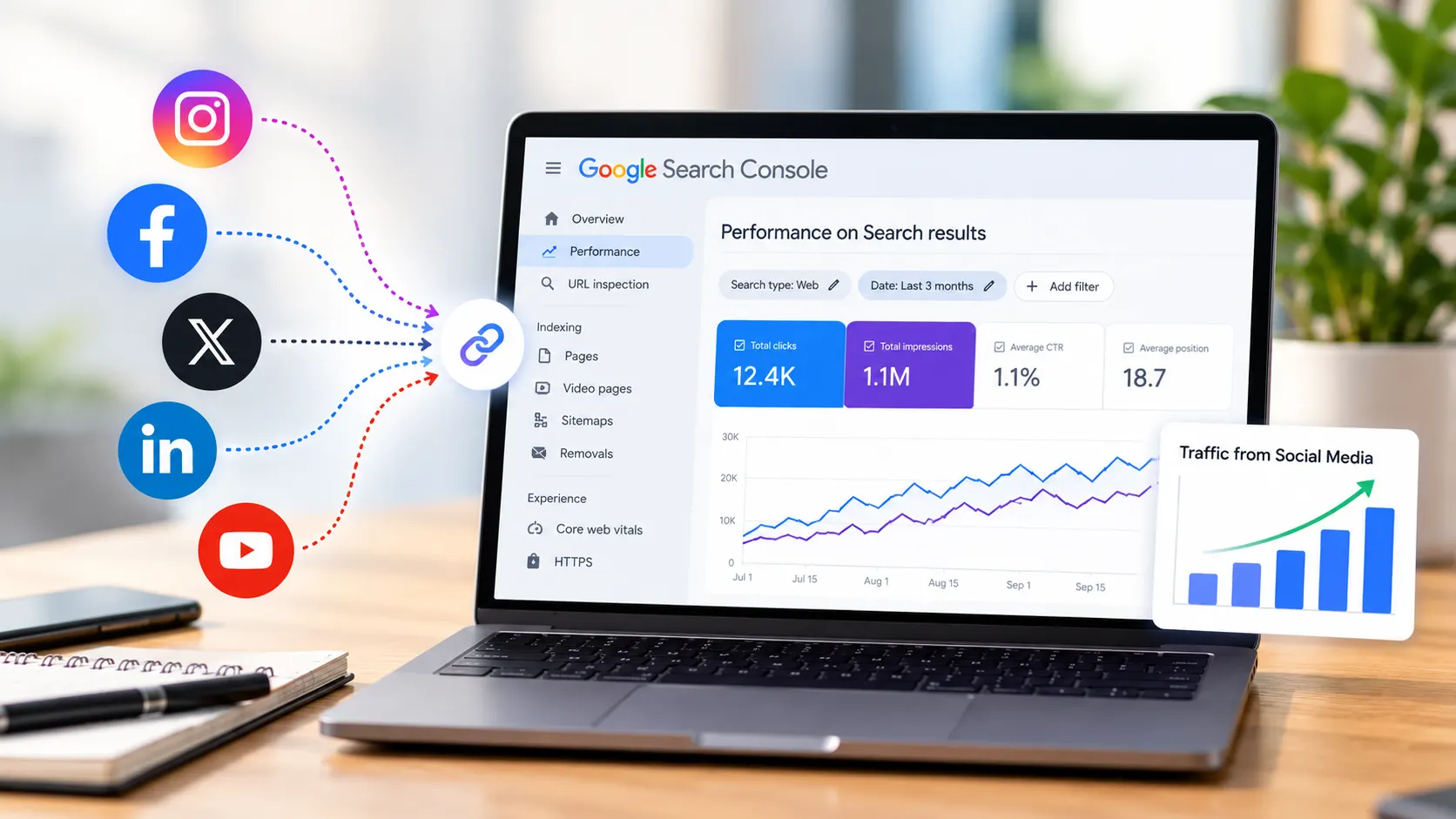
How to Add Social Media to Google Search Console and Track Their Performance
Learn how Google Search Console handles social media, what platform properties can track, and how to measure social performance alongside your website's organic search data.

Shraddha Thuwal

Domain Migration Checklist: A Step-by-Step Guide to Protect Rankings and Traffic
A successful domain migration requires careful SEO planning. Follow this checklist to manage redirects, preserve rankings, protect traffic, and avoid common migration issues.
Shraddha Thuwal
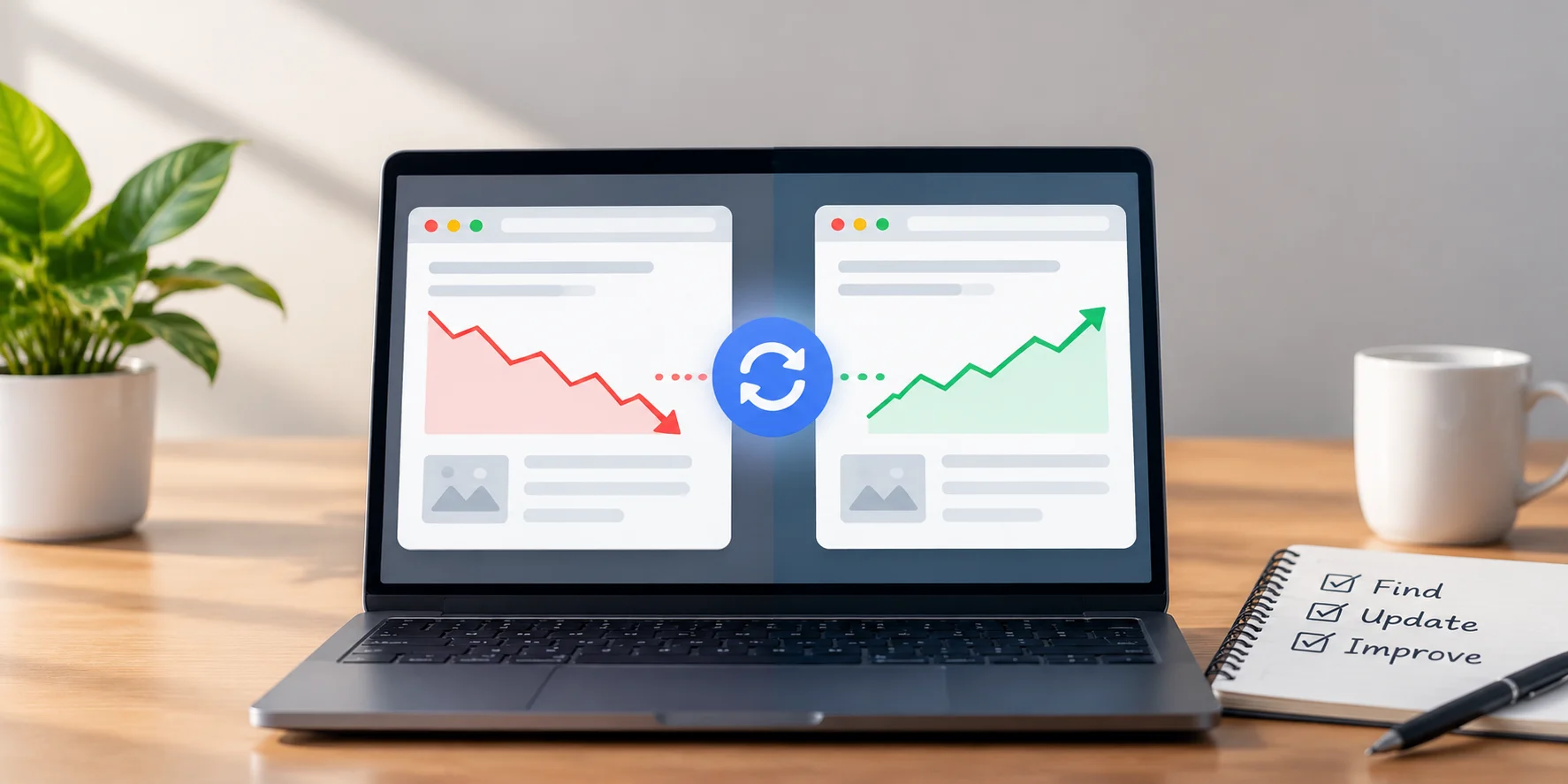
Content Decay: How to Find and Refresh Declining Pages
Content decay can reduce rankings, traffic, and AI visibility over time. Learn how to find declining pages, identify causes, and refresh content with proven SEO strategies.
Shraddha Thuwal
How to Add Social Media to Google Search Console and Track Their Performance
Learn how Google Search Console handles social media, what platform properties can track, and how to measure social performance alongside your website's organic search data.
Shraddha Thuwal
Domain Migration Checklist: A Step-by-Step Guide to Protect Rankings and Traffic
A successful domain migration requires careful SEO planning. Follow this checklist to manage redirects, preserve rankings, protect traffic, and avoid common migration issues.
Shraddha Thuwal
Get Visibility, Everywhere



























Just drop us your email and we’ll reach out
Get Visibility, Everywhere
Just drop us your email and we’ll reach out
Get Visibility, Everywhere
Just drop us your email and we’ll reach out
Our weekly newsletter contains insights from strategies we use for our clients. We don’t spam.
Copyright © 2026 Vryse
Our weekly newsletter contains insights from strategies we use for our clients. We don’t spam.
Copyright © 2026 Vryse