AI & LLM SEO
AI & LLM SEO
How to Measure AI Search Visibility and Revenue: The KPIs That Matter
How to Measure AI Search Visibility and Revenue: The KPIs That Matter
Learn how to measure AI search visibility using proven KPIs, AI visibility tracking, and AI Overview tracking to monitor citations, mentions, competitors, and business impact.

Shraddha Thuwal

Measuring AI search visibility requires tracking metrics that traditional SEO dashboards do not capture: citation frequency, mention rate, share of AI answers, brand sentiment in responses, and how these connect to traffic, leads, and revenue. Your brand can influence a buyer through an AI answer without ever receiving a click, which means session-based reporting alone will always undercount AI's impact on your pipeline.
Key Takeaways
According to Microsoft's February 2026 announcement, Bing Webmaster Tools now offers the first official AI citation dashboard from a major search engine, tracking how often your content is cited by Microsoft Copilot and Bing AI summaries.
According to McKinsey research cited by Microsoft, half of consumers already use AI-powered search, and AI search is projected to impact $750 billion in revenue by 2028.
ChatGPT holds roughly 62.6% of AI referral market share as of April 2026, but Perplexity's referral traffic converts at meaningfully higher rates than standard organic search, making platform-specific tracking essential.
Traditional SEO metrics (rankings, clicks, sessions) miss the majority of AI-driven influence because AI answers often satisfy queries before any click occurs.
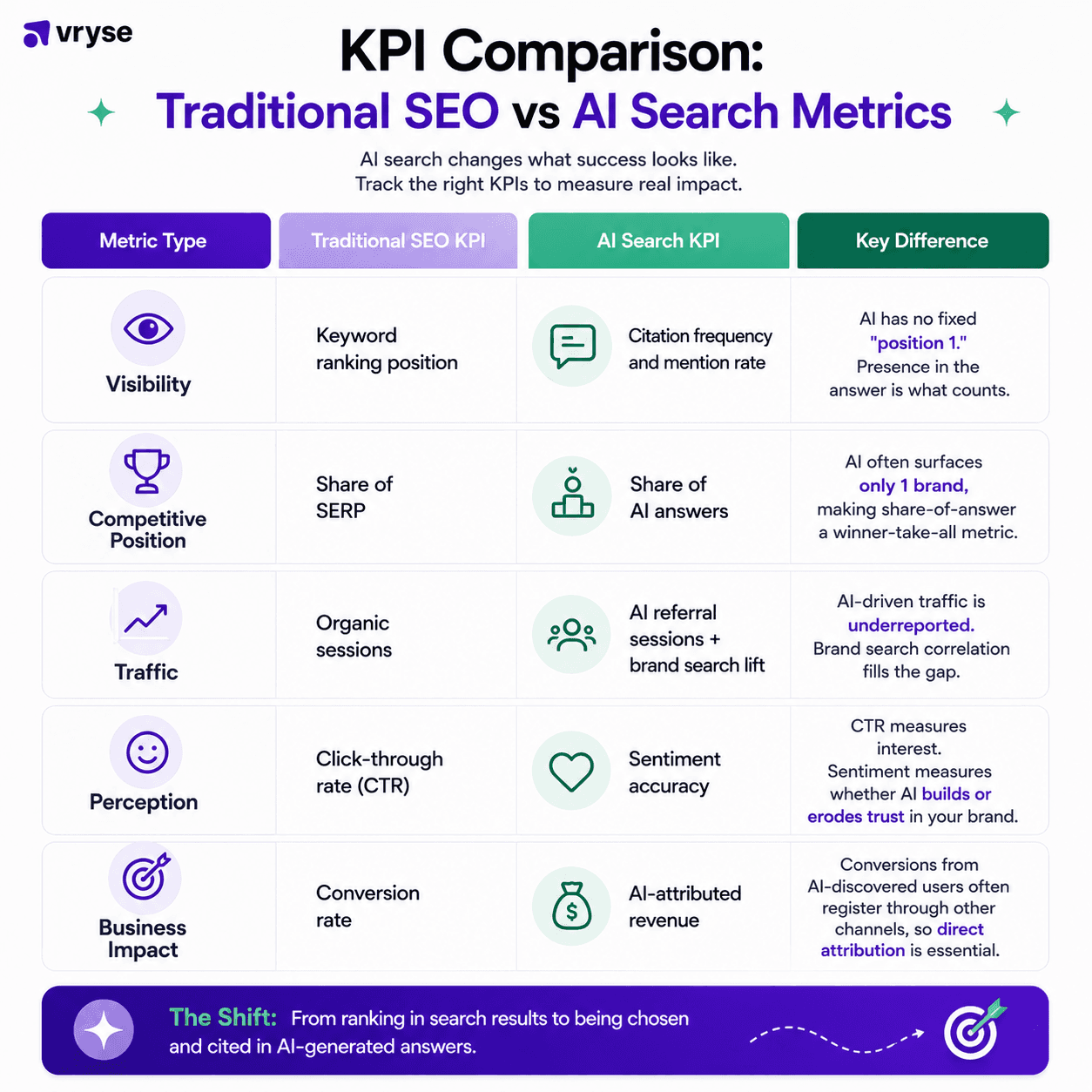
The five KPIs that matter: citation frequency, mention rate, share of answers, sentiment accuracy, and AI-attributed revenue.
Why Traditional SEO Reporting Falls Short for AI Search
Traditional SEO reports track clicks, keyword rankings, impressions, traffic, and conversions. These metrics assume a user clicks a link before your brand gets credit. AI search breaks that assumption.
When ChatGPT recommends a CRM, there are often no links in the answer. The user either searches Google next (and that session gets attributed to Google organic) or types the brand URL directly (which shows up as direct traffic). Either way, the AI platform gets no credit in your analytics.
According to an Eight Oh Two AI and Search Behavior study (2026), 37% of consumers now start searches with AI rather than Google, but 85% still cross-reference through traditional search before converting.
As Vryse founder Ashish Kamathi noted: "Asking ChatGPT once in a while if it knows your brand is not really a strategy. A good AI search tool should track mention rate, citation rate, share of answers, page-level visibility, and most importantly, how all of this connects back to traffic, leads, and revenue. Because AI visibility only matters if it helps the business."

Understanding what GEO means in practice is the foundation for understanding why these new KPIs exist.
The 5 KPIs That Actually Measure AI Search Visibility
Citation frequency
What it measures: How often AI platforms reference your domain, brand, or specific pages when generating answers.
Why it matters: This is the closest equivalent to a "visibility score" in AI search. A brand appearing in 30% of tracked AI queries has a measurable baseline. If that drops to 15%, something changed in how models index or retrieve your content.
How to track it: Bing Webmaster Tools' AI Performance dashboard tracks this natively for Microsoft Copilot and Bing AI summaries. For ChatGPT, Perplexity, and Gemini, third-party tools or manual prompt audits are required.
Mention rate
What it measures: The percentage of relevant AI responses that include your brand name and whether a link is present.
Why it matters: AI answers don't always include links. A brand mentioned by name in a ChatGPT recommendation drives Google brand searches and direct visits, even without a click from the AI platform itself. Mentions without links still influence buyer decisions.
How to track it: Run a set of 50 to 100 core buyer queries across ChatGPT, Gemini, Perplexity, and Google AI Mode monthly. Record whether your brand is named in each response.
Share of AI answers
What it measures: Your brand's presence in AI responses relative to competitors for the same set of queries.
Why it matters: This is the AI equivalent of share of voice. If your competitor appears in 40% of responses for your target queries and you appear in 12%, the gap is quantified and actionable.
How to track it: Track the same prompt set across platforms for both your brand and named competitors. Bing's June 2026 update added a Citation Share metric and Compare feature specifically for this purpose within Microsoft's ecosystem.
Sentiment accuracy
What it measures: Whether AI platforms describe your brand accurately and positively when they mention it.
Why it matters: Being cited is not enough if the AI describes your product incorrectly, highlights outdated limitations, or surfaces negative reviews. Sentiment directly affects whether a citation converts to a lead.
How to track it: For each mention, log whether the AI's description is accurate, positive, neutral, or negative. Flag inaccuracies as content problems: if an AI misrepresents your pricing or features, the fix is updating the source content it's pulling from.
AI-attributed revenue
What it measures: Revenue, leads, or conversions that can be traced back to AI-driven discovery, even when the final conversion happens through Google or direct traffic.
Why it matters: This metric justifies AI visibility investment to leadership. Without it, AI search remains a branding exercise with no budget case.
How to track it: Three practical methods:
Self-reported attribution: Add "How did you hear about us?" to demo forms and checkout flows. Include AI options (ChatGPT, Perplexity, "AI search") alongside Google and referral.
Brand search lift correlation: Track branded Google search volume alongside AI citation frequency. A consistent correlation indicates that AI is driving increases in brand search.
GA4 AI traffic segmentation: Filter referral traffic from chatgpt.com, perplexity.ai, and other AI platforms in Google Analytics to measure direct AI-sourced sessions, knowing this will always be an undercount.
Which AI Platforms Should You Track?
Tracking only ChatGPT because it has the largest market share is a common mistake. Perplexity's referral traffic converts at higher rates, and Bing's Copilot is the only platform offering official citation data. A complete AI visibility tracking setup covers all six surfaces.
Platform | Why it matters | How to track AI overview tracking and citations |
Google AI Overviews | Highest-volume AI surface. Appears on roughly 16-50% of US queries depending on query type. | Google Search Console (partial), third-party AI visibility tools |
Google AI Mode | Separate from AI Overviews. Handles complex, multi-turn queries. | Requires separate prompt tracking. Not yet in Search Console. |
ChatGPT | ~62.6% of AI referral market share. Dominant for product research and comparisons. | Manual prompt audits, third-party tracking tools |
Perplexity | Citation-forward by design. Higher conversion rates per referral than organic search. | Most measurable platform due to explicit source citations |
Gemini | Google's standalone AI assistant. Distinct from AI Overviews. Grounded in Google Maps for local queries. | Manual tracking; no dedicated dashboard yet |
Microsoft Copilot | Bing AI Performance dashboard provides official citation data. | Bing Webmaster Tools AI Performance (free, official) |
How to Run Your First AI Visibility Audit: A Step-by-Step Checklist
Before you start:
Build a list of 50 to 100 buyer queries across awareness, evaluation, and decision stages
Include branded queries ("Is [your brand] good for X?") and unbranded queries ("best X for Y").
Identify 3 to 5 named competitors to track alongside your brand.
Run the Audit:
Prompt each query across ChatGPT, Gemini, Perplexity, and Google AI Mode.
For each response, record whether your brand was mentioned. Where in the response (top, middle, bottom)? Was a source link included? Was the tone positive, neutral, or negative? Was the description accurate?
Repeat for each competitor on the same query set.
After the Audit:
Calculate your citation frequency (mentions / total queries)
Calculate share of answers vs each competitor
Flag any sentiment or accuracy issues with specific source content to fix
Set up Bing Webmaster Tools AI Performance for ongoing Copilot tracking
Schedule monthly re-runs to track trend direction
Without it, every optimization decision is a guess. Vryse's AI visibility dashboard automates this tracking across all major platforms, so teams can focus on acting on the data rather than collecting it.
What Does 30% Incremental Growth From AEO Actually Look Like?
On average, Vryse clients who implement AEO on top of existing SEO efforts see about 30% incremental growth, according to their analysis of client data.
The 30% comes on top of whatever organic traffic and leads the brand was already generating. It represents the buyers who would have been lost to competitors in AI answers if the brand had optimized only for Google.
For specific verticals, Vryse's case studies show what this looks like in practice:
Healthtech (Infiheal): 400% increase in AI traffic within 3 months
B2B marketplace (FF21): 500% growth in qualified leads from AI presence
Both results were achieved while maintaining and growing existing SEO performance. The key is that AEO and SEO are complementary strategies, not competing ones. A brand optimized for both surfaces captures buyers at every stage of the research journey, regardless of which platform they start on.
Common Measurement Mistakes to Avoid
Tracking only traffic from AI platforms. AI traffic in Google Analytics will always be an undercount. Many AI-influenced visitors arrive through Google organic or direct channels, with no AI attribution. Use brand search lift and self-reported attribution alongside session data.
Sampling once and calling it done. AI systems update retrieval behavior constantly. A single snapshot tells you almost nothing about trend direction. Monthly audits are the minimum cadence; weekly is better for competitive categories.
Ignoring sentiment in favor of volume. Being cited in 40% of AI responses is meaningless if the AI describes your product as "expensive and difficult to implement." Sentiment accuracy is the metric that determines whether a citation drives revenue or repels buyers.
Reporting AI metrics in SEO language. Telling leadership "our AI citation rate grew from 12% to 29% this quarter, and AI-referred revenue is up 64%" is more useful than "sessions declined 8%." The framing determines whether AI visibility gets budget or gets cut.
Measuring AI search visibility requires tracking metrics that traditional SEO dashboards do not capture: citation frequency, mention rate, share of AI answers, brand sentiment in responses, and how these connect to traffic, leads, and revenue. Your brand can influence a buyer through an AI answer without ever receiving a click, which means session-based reporting alone will always undercount AI's impact on your pipeline.
Key Takeaways
According to Microsoft's February 2026 announcement, Bing Webmaster Tools now offers the first official AI citation dashboard from a major search engine, tracking how often your content is cited by Microsoft Copilot and Bing AI summaries.
According to McKinsey research cited by Microsoft, half of consumers already use AI-powered search, and AI search is projected to impact $750 billion in revenue by 2028.
ChatGPT holds roughly 62.6% of AI referral market share as of April 2026, but Perplexity's referral traffic converts at meaningfully higher rates than standard organic search, making platform-specific tracking essential.
Traditional SEO metrics (rankings, clicks, sessions) miss the majority of AI-driven influence because AI answers often satisfy queries before any click occurs.
The five KPIs that matter: citation frequency, mention rate, share of answers, sentiment accuracy, and AI-attributed revenue.
Why Traditional SEO Reporting Falls Short for AI Search
Traditional SEO reports track clicks, keyword rankings, impressions, traffic, and conversions. These metrics assume a user clicks a link before your brand gets credit. AI search breaks that assumption.
When ChatGPT recommends a CRM, there are often no links in the answer. The user either searches Google next (and that session gets attributed to Google organic) or types the brand URL directly (which shows up as direct traffic). Either way, the AI platform gets no credit in your analytics.
According to an Eight Oh Two AI and Search Behavior study (2026), 37% of consumers now start searches with AI rather than Google, but 85% still cross-reference through traditional search before converting.
As Vryse founder Ashish Kamathi noted: "Asking ChatGPT once in a while if it knows your brand is not really a strategy. A good AI search tool should track mention rate, citation rate, share of answers, page-level visibility, and most importantly, how all of this connects back to traffic, leads, and revenue. Because AI visibility only matters if it helps the business."
Understanding what GEO means in practice is the foundation for understanding why these new KPIs exist.
The 5 KPIs That Actually Measure AI Search Visibility
Citation frequency
What it measures: How often AI platforms reference your domain, brand, or specific pages when generating answers.
Why it matters: This is the closest equivalent to a "visibility score" in AI search. A brand appearing in 30% of tracked AI queries has a measurable baseline. If that drops to 15%, something changed in how models index or retrieve your content.
How to track it: Bing Webmaster Tools' AI Performance dashboard tracks this natively for Microsoft Copilot and Bing AI summaries. For ChatGPT, Perplexity, and Gemini, third-party tools or manual prompt audits are required.
Mention rate
What it measures: The percentage of relevant AI responses that include your brand name and whether a link is present.
Why it matters: AI answers don't always include links. A brand mentioned by name in a ChatGPT recommendation drives Google brand searches and direct visits, even without a click from the AI platform itself. Mentions without links still influence buyer decisions.
How to track it: Run a set of 50 to 100 core buyer queries across ChatGPT, Gemini, Perplexity, and Google AI Mode monthly. Record whether your brand is named in each response.
Share of AI answers
What it measures: Your brand's presence in AI responses relative to competitors for the same set of queries.
Why it matters: This is the AI equivalent of share of voice. If your competitor appears in 40% of responses for your target queries and you appear in 12%, the gap is quantified and actionable.
How to track it: Track the same prompt set across platforms for both your brand and named competitors. Bing's June 2026 update added a Citation Share metric and Compare feature specifically for this purpose within Microsoft's ecosystem.
Sentiment accuracy
What it measures: Whether AI platforms describe your brand accurately and positively when they mention it.
Why it matters: Being cited is not enough if the AI describes your product incorrectly, highlights outdated limitations, or surfaces negative reviews. Sentiment directly affects whether a citation converts to a lead.
How to track it: For each mention, log whether the AI's description is accurate, positive, neutral, or negative. Flag inaccuracies as content problems: if an AI misrepresents your pricing or features, the fix is updating the source content it's pulling from.
AI-attributed revenue
What it measures: Revenue, leads, or conversions that can be traced back to AI-driven discovery, even when the final conversion happens through Google or direct traffic.
Why it matters: This metric justifies AI visibility investment to leadership. Without it, AI search remains a branding exercise with no budget case.
How to track it: Three practical methods:
Self-reported attribution: Add "How did you hear about us?" to demo forms and checkout flows. Include AI options (ChatGPT, Perplexity, "AI search") alongside Google and referral.
Brand search lift correlation: Track branded Google search volume alongside AI citation frequency. A consistent correlation indicates that AI is driving increases in brand search.
GA4 AI traffic segmentation: Filter referral traffic from chatgpt.com, perplexity.ai, and other AI platforms in Google Analytics to measure direct AI-sourced sessions, knowing this will always be an undercount.
Which AI Platforms Should You Track?
Tracking only ChatGPT because it has the largest market share is a common mistake. Perplexity's referral traffic converts at higher rates, and Bing's Copilot is the only platform offering official citation data. A complete AI visibility tracking setup covers all six surfaces.
Platform | Why it matters | How to track AI overview tracking and citations |
Google AI Overviews | Highest-volume AI surface. Appears on roughly 16-50% of US queries depending on query type. | Google Search Console (partial), third-party AI visibility tools |
Google AI Mode | Separate from AI Overviews. Handles complex, multi-turn queries. | Requires separate prompt tracking. Not yet in Search Console. |
ChatGPT | ~62.6% of AI referral market share. Dominant for product research and comparisons. | Manual prompt audits, third-party tracking tools |
Perplexity | Citation-forward by design. Higher conversion rates per referral than organic search. | Most measurable platform due to explicit source citations |
Gemini | Google's standalone AI assistant. Distinct from AI Overviews. Grounded in Google Maps for local queries. | Manual tracking; no dedicated dashboard yet |
Microsoft Copilot | Bing AI Performance dashboard provides official citation data. | Bing Webmaster Tools AI Performance (free, official) |
How to Run Your First AI Visibility Audit: A Step-by-Step Checklist
Before you start:
Build a list of 50 to 100 buyer queries across awareness, evaluation, and decision stages
Include branded queries ("Is [your brand] good for X?") and unbranded queries ("best X for Y").
Identify 3 to 5 named competitors to track alongside your brand.
Run the Audit:
Prompt each query across ChatGPT, Gemini, Perplexity, and Google AI Mode.
For each response, record whether your brand was mentioned. Where in the response (top, middle, bottom)? Was a source link included? Was the tone positive, neutral, or negative? Was the description accurate?
Repeat for each competitor on the same query set.
After the Audit:
Calculate your citation frequency (mentions / total queries)
Calculate share of answers vs each competitor
Flag any sentiment or accuracy issues with specific source content to fix
Set up Bing Webmaster Tools AI Performance for ongoing Copilot tracking
Schedule monthly re-runs to track trend direction
Without it, every optimization decision is a guess. Vryse's AI visibility dashboard automates this tracking across all major platforms, so teams can focus on acting on the data rather than collecting it.
What Does 30% Incremental Growth From AEO Actually Look Like?
On average, Vryse clients who implement AEO on top of existing SEO efforts see about 30% incremental growth, according to their analysis of client data.
The 30% comes on top of whatever organic traffic and leads the brand was already generating. It represents the buyers who would have been lost to competitors in AI answers if the brand had optimized only for Google.
For specific verticals, Vryse's case studies show what this looks like in practice:
Healthtech (Infiheal): 400% increase in AI traffic within 3 months
B2B marketplace (FF21): 500% growth in qualified leads from AI presence
Both results were achieved while maintaining and growing existing SEO performance. The key is that AEO and SEO are complementary strategies, not competing ones. A brand optimized for both surfaces captures buyers at every stage of the research journey, regardless of which platform they start on.
Common Measurement Mistakes to Avoid
Tracking only traffic from AI platforms. AI traffic in Google Analytics will always be an undercount. Many AI-influenced visitors arrive through Google organic or direct channels, with no AI attribution. Use brand search lift and self-reported attribution alongside session data.
Sampling once and calling it done. AI systems update retrieval behavior constantly. A single snapshot tells you almost nothing about trend direction. Monthly audits are the minimum cadence; weekly is better for competitive categories.
Ignoring sentiment in favor of volume. Being cited in 40% of AI responses is meaningless if the AI describes your product as "expensive and difficult to implement." Sentiment accuracy is the metric that determines whether a citation drives revenue or repels buyers.
Reporting AI metrics in SEO language. Telling leadership "our AI citation rate grew from 12% to 29% this quarter, and AI-referred revenue is up 64%" is more useful than "sessions declined 8%." The framing determines whether AI visibility gets budget or gets cut.
Frequently Asked Questions
Frequently Asked Questions
Is there a free tool to start measuring AI search visibility today?
Yes. Bing Webmaster Tools' AI Performance dashboard, launched in February 2026, is free and tracks citation data across Microsoft Copilot and Bing AI summaries. It does not cover ChatGPT, Perplexity, or Google AI Overviews, but it provides the only official, structured AI citation data currently available from a major search engine.
How often should I audit AI visibility across platforms?
Monthly at minimum for trend tracking. Weekly for competitive categories where AI answer composition changes frequently. The audit should cover the same prompt set each time so you can compare data over consistent timeframes, not just snapshots.
Can I measure AI visibility without a paid tool?
Yes, through manual prompt audits. Build a spreadsheet with your target queries, run them across each AI platform monthly, and record citation, mention, sentiment, and position data. This takes time but gives you a baseline before investing in automation. Vryse's AI visibility dashboard automates this across all major platforms for brands ready to scale beyond manual tracking.
How do I connect AI visibility to revenue for a board or leadership report?
Combine three data points: self-reported attribution from lead forms ("How did you hear about us?"), correlation between AI citation frequency and branded Google search volume over the same period, and GA4 traffic segmented by AI referral sources. Present these together as a composite picture rather than relying on any single attribution path.
Related Articles
Related Articles
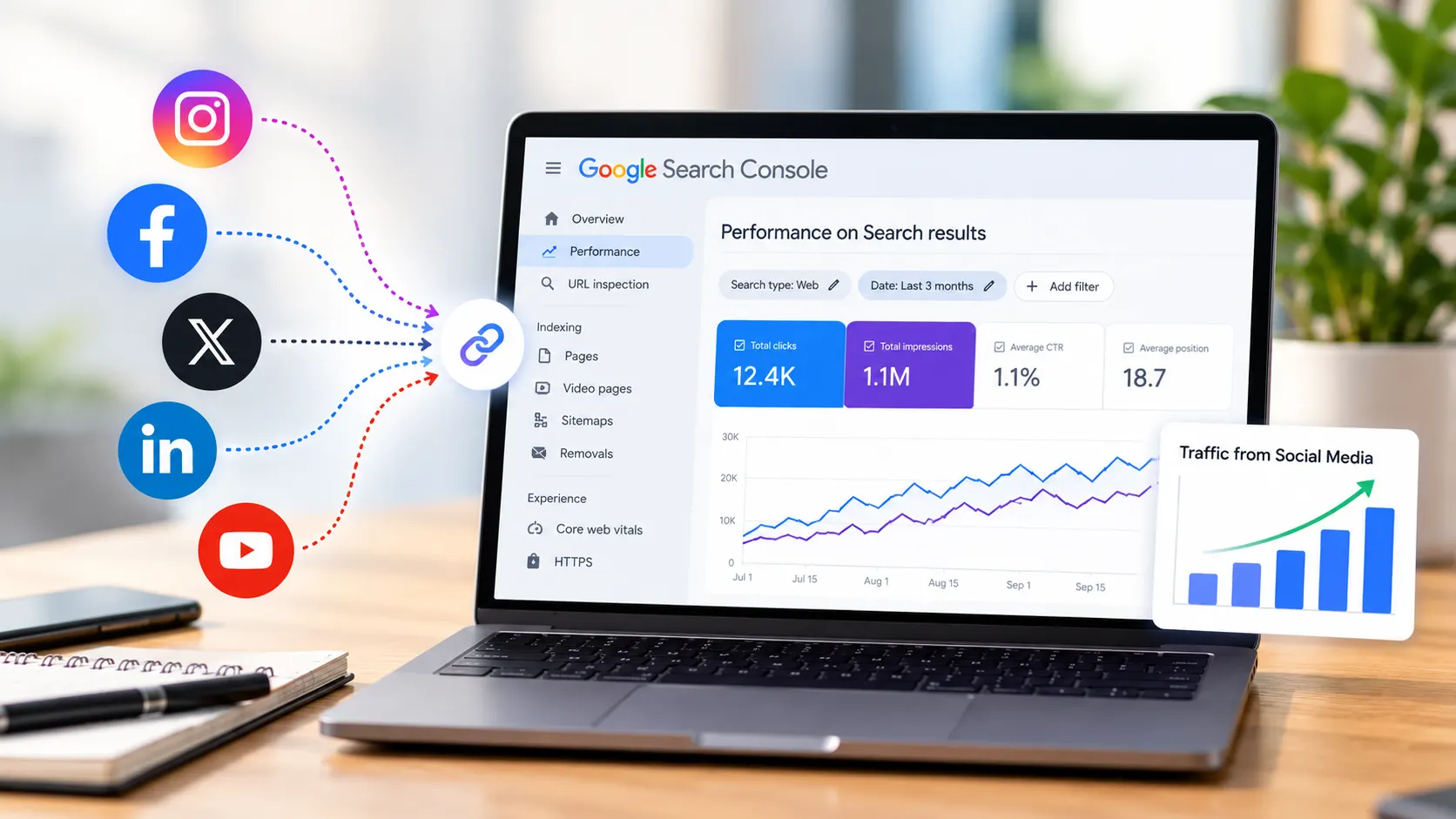
How to Add Social Media to Google Search Console and Track Their Performance
Learn how Google Search Console handles social media, what platform properties can track, and how to measure social performance alongside your website's organic search data.

Shraddha Thuwal
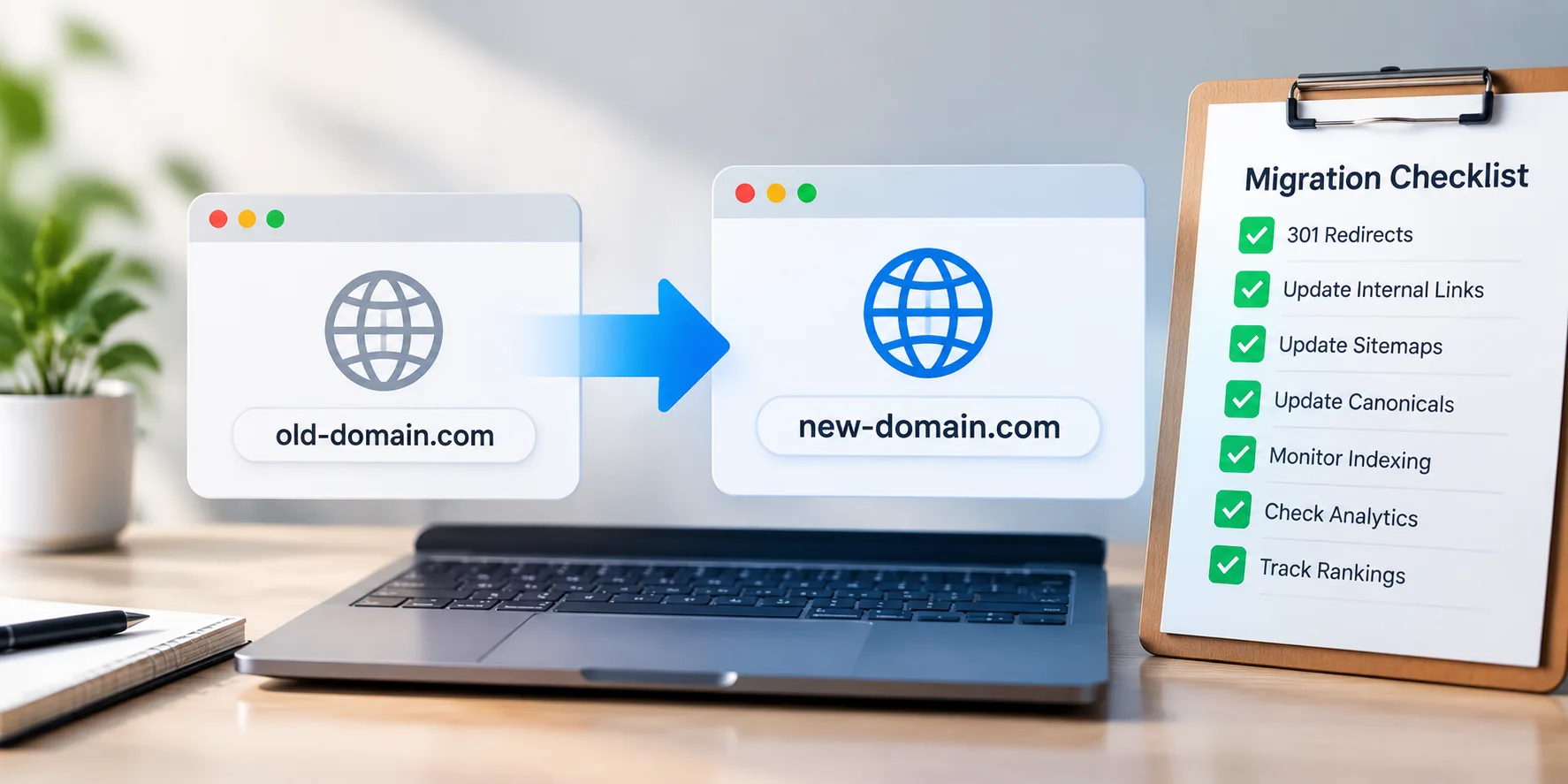
Domain Migration Checklist: A Step-by-Step Guide to Protect Rankings and Traffic
A successful domain migration requires careful SEO planning. Follow this checklist to manage redirects, preserve rankings, protect traffic, and avoid common migration issues.
Shraddha Thuwal
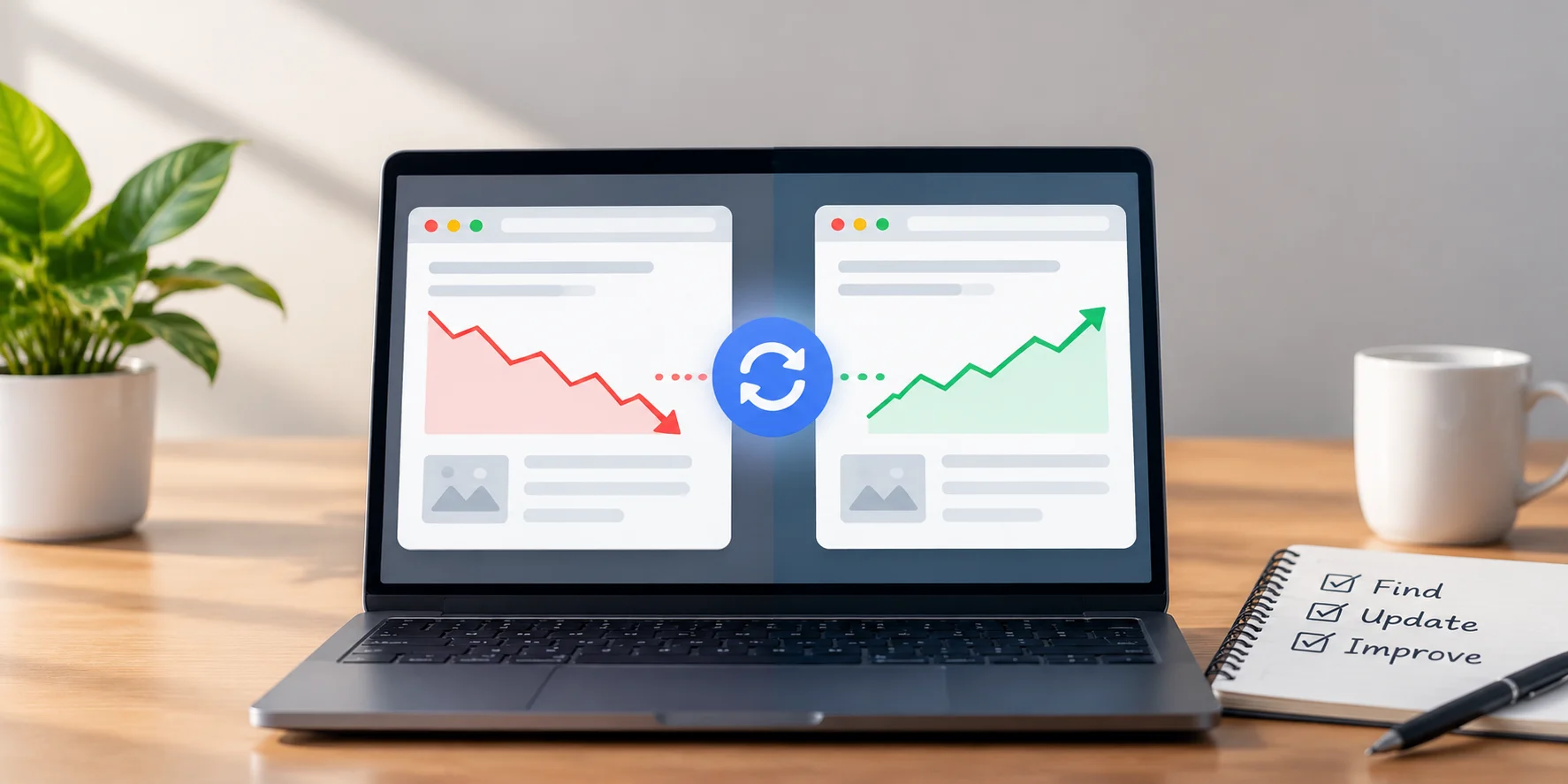
Content Decay: How to Find and Refresh Declining Pages
Content decay can reduce rankings, traffic, and AI visibility over time. Learn how to find declining pages, identify causes, and refresh content with proven SEO strategies.
Shraddha Thuwal
How to Add Social Media to Google Search Console and Track Their Performance
Learn how Google Search Console handles social media, what platform properties can track, and how to measure social performance alongside your website's organic search data.
Shraddha Thuwal
Domain Migration Checklist: A Step-by-Step Guide to Protect Rankings and Traffic
A successful domain migration requires careful SEO planning. Follow this checklist to manage redirects, preserve rankings, protect traffic, and avoid common migration issues.
Shraddha Thuwal
Get Visibility, Everywhere



























Just drop us your email and we’ll reach out
Get Visibility, Everywhere
Just drop us your email and we’ll reach out
Get Visibility, Everywhere
Just drop us your email and we’ll reach out
Our weekly newsletter contains insights from strategies we use for our clients. We don’t spam.
Copyright © 2026 Vryse
Our weekly newsletter contains insights from strategies we use for our clients. We don’t spam.
Copyright © 2026 Vryse